
Building Tour - Elizabeth Line Transforming London Through Infrastructure and Design
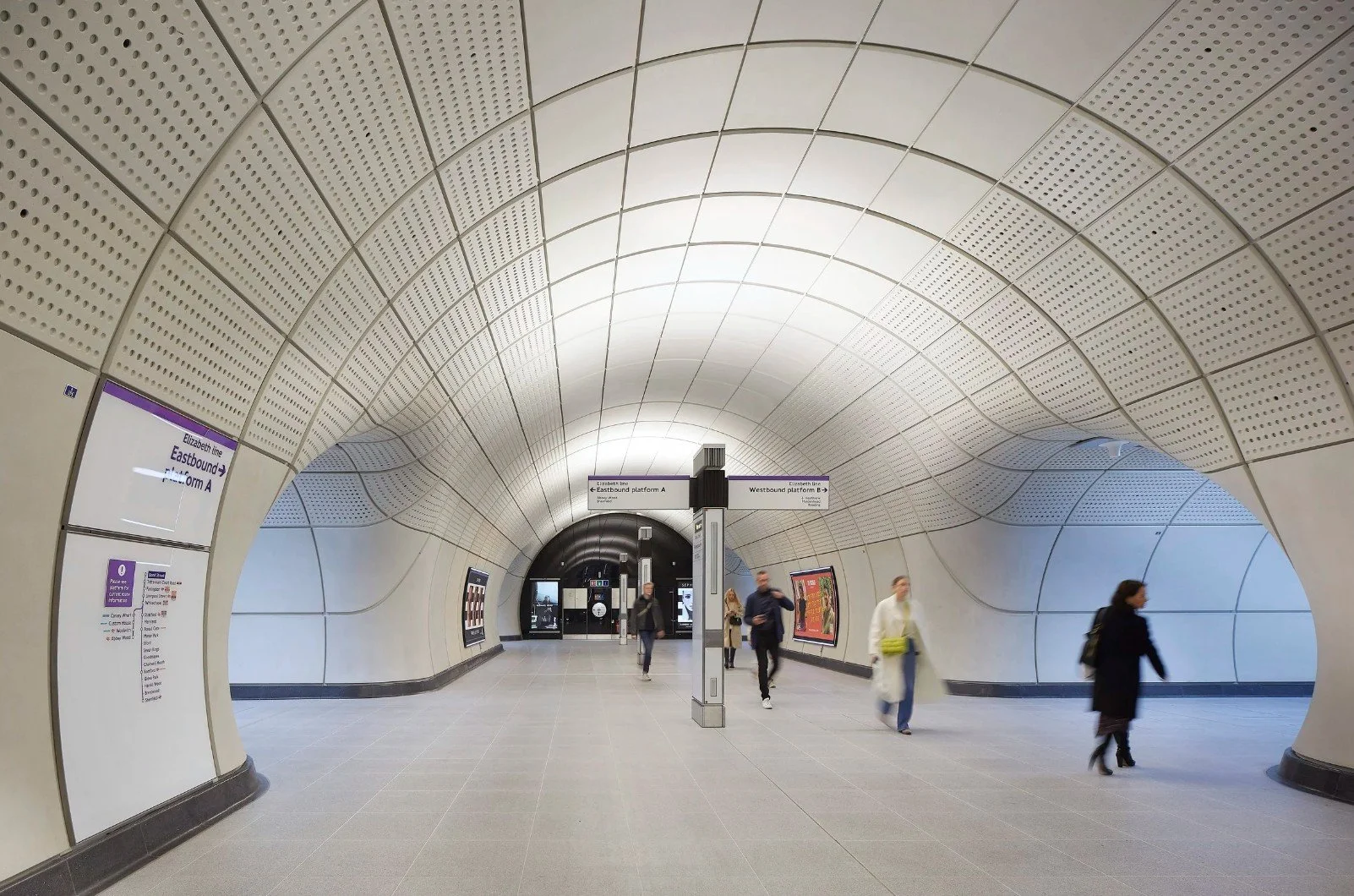
Photo credit: Grimshaw/Hufton+Crow
On 16 April, members of the AIA UK had the opportunity to experience the Elizabeth Line firsthand through an exclusive tour led by representatives from Grimshaw.
The visit began at Grimshaw’s Clerkenwell studio, just moments from Farringdon Station, where Neil McClements and Graham Gibbon presented the design development behind one of Europe’s largest recent infrastructure projects. Since its full integration in 2023, the Elizabeth Line has fundamentally transformed travel across London, connecting Berkshire and Essex through approximately 117 kilometres of railway and 41 stations.
Developed through a collaboration between Grimshaw, AtkinsRéalis, design firm Maynard, and lighting consultants Equation, the project established a comprehensive “line-wide strategy” that unified architecture, interiors, wayfinding, and passenger experience across the network. The Elizabeth Line was recognised with the 2024 RIBA Stirling Prize for its outstanding contribution to British architecture.
Neil McClements explained that while the consortium developed the overarching design language and passenger environment, individual stations were designed by a range of architectural practices, each responding uniquely to its urban context at street level. As passengers descend into the stations, however, a consistent architectural identity emerges through the application of unified cladding systems, lighting, signage, and spatial design strategies that conceptually and functionally bind the network together.
Graham Gibbon further contextualised the project by describing the extensive attention given to the design of every component, from the curved glass-fibre reinforced concrete cladding to the integrated technology and illuminated wayfinding totems. The use of consistent line-wide elements enabled efficiencies in manufacturing and construction while ensuring durability, clarity, and visual continuity throughout the system. Importantly, Crossrail’s commitment to full-scale mock-ups and rigorous testing allowed the design team to refine and validate solutions that ultimately contributed to the project’s award-winning outcome.
The signature white cladding, with its softly flared geometries, enhances visibility, improves passenger safety, and creates a calm, cohesive spatial experience. Freestanding totems provide clear and intuitive wayfinding, seamlessly integrating graphics, lighting, and passenger information.
Following the presentation, the group toured Farringdon Station before travelling on the Elizabeth Line to Tottenham Court Road Station and back. The journey offered participants the opportunity to experience firsthand the line’s carefully considered architecture, detailing, materiality, and passenger environment. Along the route, Neil and Graham highlighted key design features ranging from integrated artwork and graphics to seating, lighting, and spatial organisation — all conceived as integral components of a unified architectural vision.
The tour provided a valuable insight into how thoughtful, coordinated design at both urban and infrastructural scales can elevate the experience of public transportation while contributing meaningfully to the identity of the city.
Written by Gregory Fonseca, AIA
