
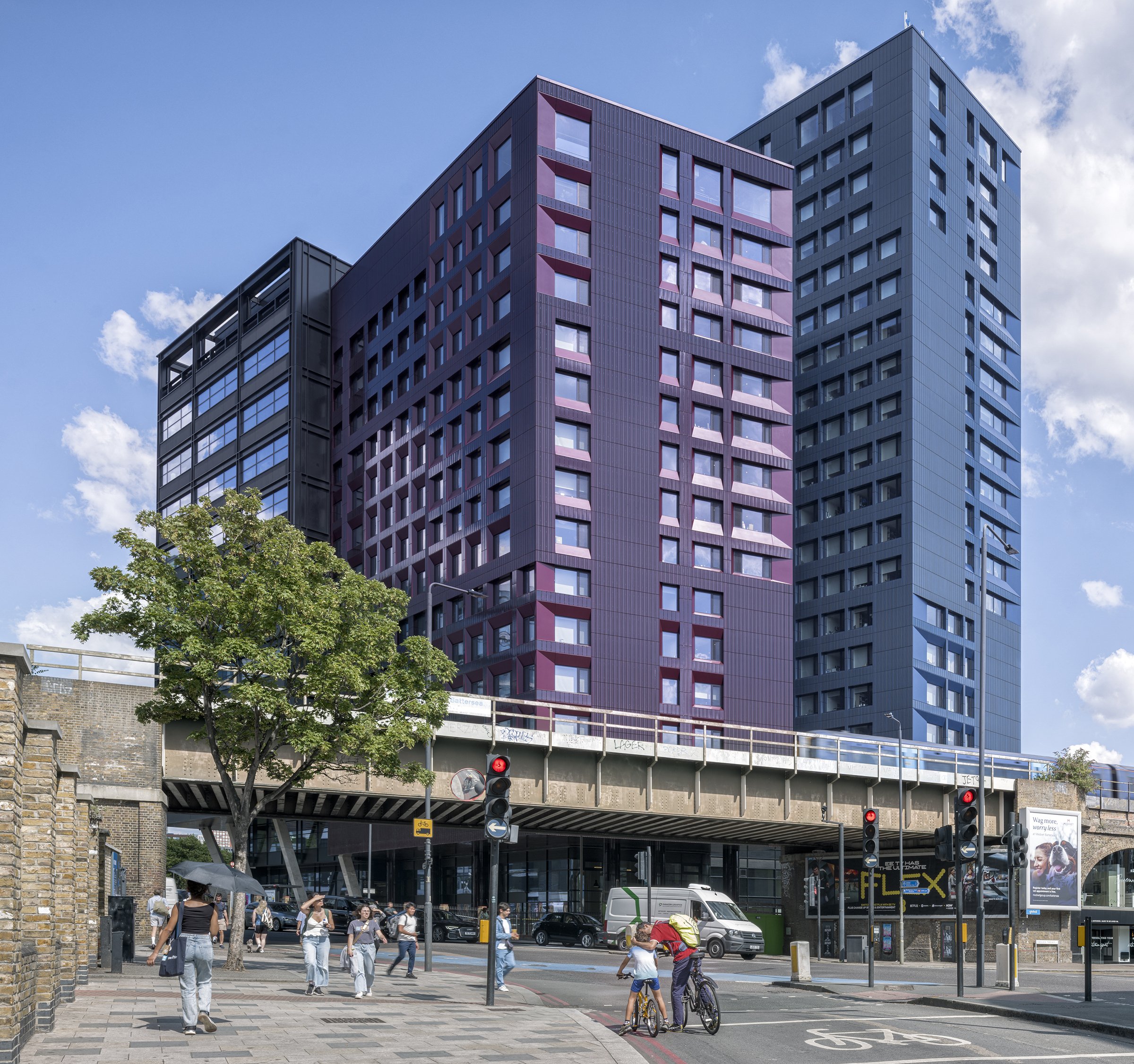
Photo credit AHMM
On 9 October, we had the opportunity to tour Urbanest Battersea in person. Urbanest positions itself as London’s leading student accommodation provider, with nine distinctive properties across central London. With 853 student beds distributed across buildings reaching up to 19 storeys, Urbanest Battersea is also Europe’s largest student accommodation development constructed to Passivhaus standards. Having previously toured Urbanest City by Hopkins Architects in June, I can say without reservation that Urbanest’s approach meaningfully redefines contemporary student housing.
The student rooms are well considered, each incorporating a bed, built-in desk and chair, wardrobe, and a private shower room. Comfort cooling and heating are provided alongside an air-filtration system and augmented acoustic dampening. Clusters of rooms share fully furnished communal kitchens with generous dining areas. Public amenities are extensive and of a notably high standard, including a gym, cinema room, rooftop terraces offering expansive city views, and a variety of communal study spaces. Attention to detail and finishes is consistently strong throughout.
Designed by AHHM, Urbanest Battersea recently became the UK’s largest certified Passivhaus development after passing a demanding series of airtightness tests. Located on the south side of Battersea Park Road, opposite the emerging Battersea Power Station district, the scheme comprises three student residential buildings and a dedicated commercial building, forming a highly sustainable and thoughtfully articulated ensemble.
Three of the four buildings are connected by a shared podium, with heights ranging from 11 to 19 storeys and creating a dynamic skyline. Our guide, Flora Genel, explained that the staggered building heights and stepping massing are deliberately arranged to frame key views, while the podium unifies the scheme around landscaped courtyard gardens. She also highlighted the glazed terracotta façades—rendered in a vibrant palette of red, green, and blue—which reference the area’s industrial heritage as well as the surrounding brickwork, local flora, and sky.
The design, like many contemporary student residential schemes, encourages social interaction. The three interconnected residential cores (colour-coded to match the terracotta façades) converge at podium level. This area also accommodates a public house, café, and an Enterprise Business Unit (EBU), which offers a flexible community hub for cultural events and workspace. The combination of a socially oriented design strategy, careful materiality, low-energy performance, and exemplary Passivhaus credentials—in addition to outstanding living and amenity spaces—positions Urbanest Battersea as a standout model for student accommodation in London.
Written by Gregory Fonseca, AIA
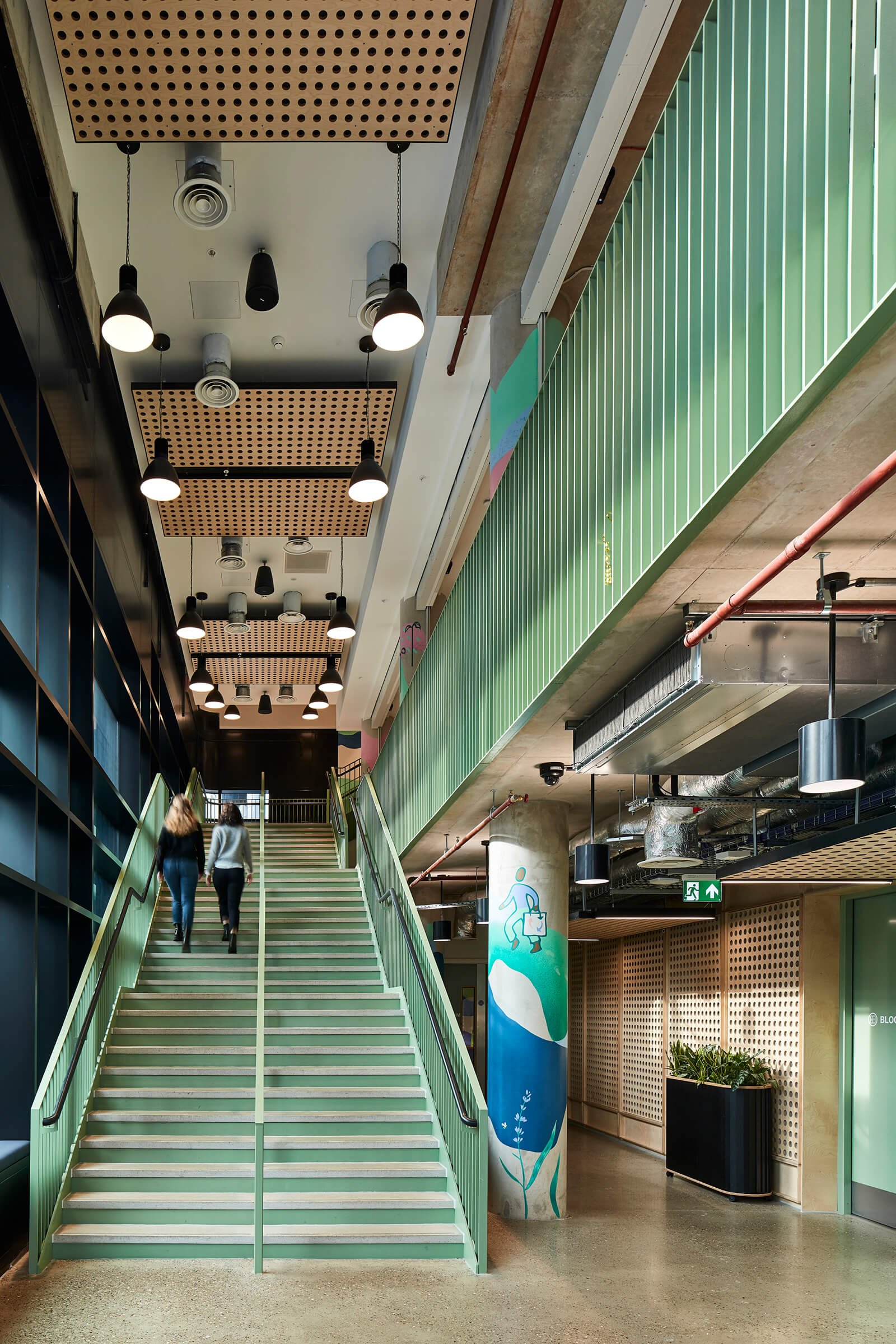
Photo credit AHMM
