AIA Student Charrette 2021 - A Tale of New Cities
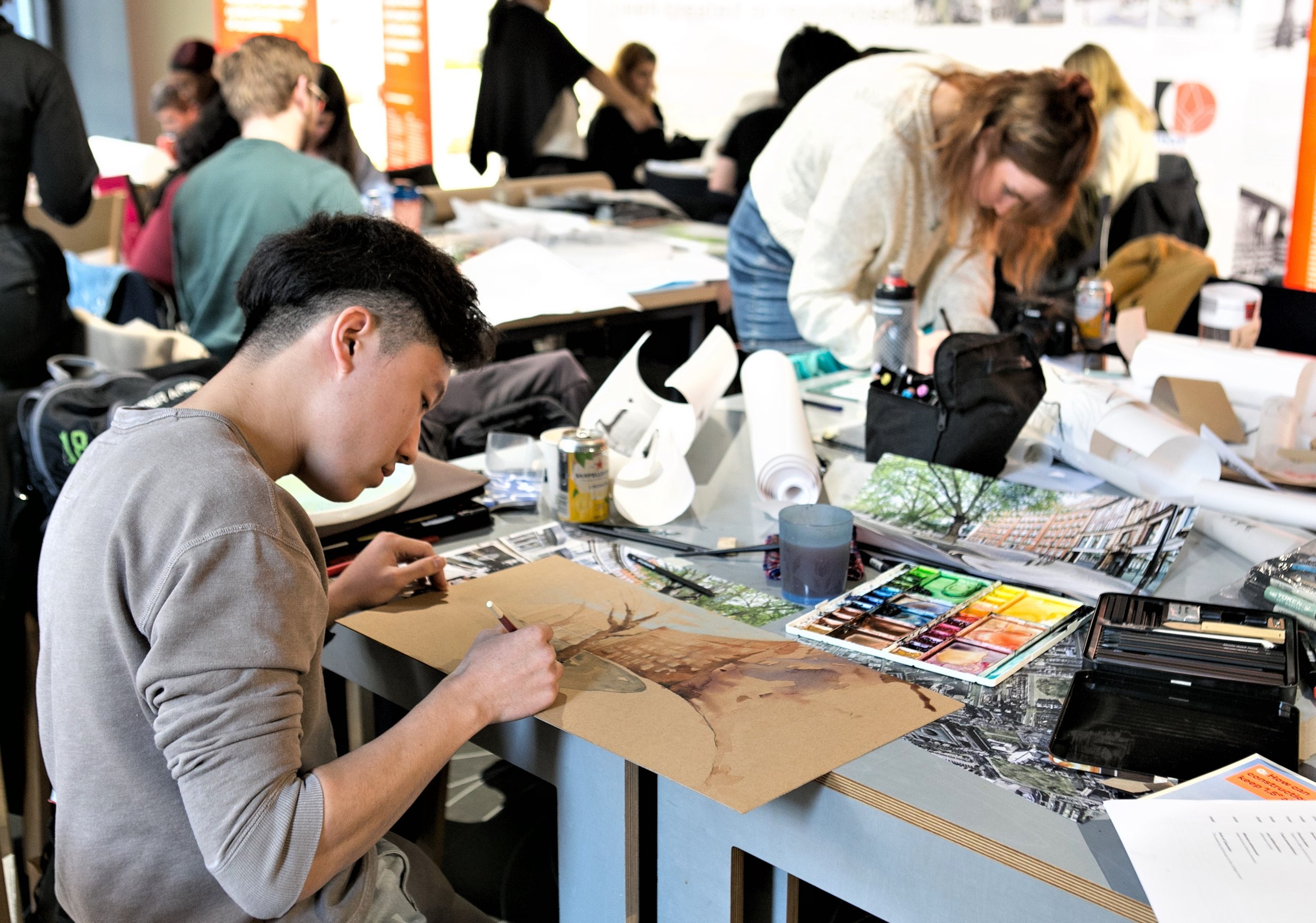
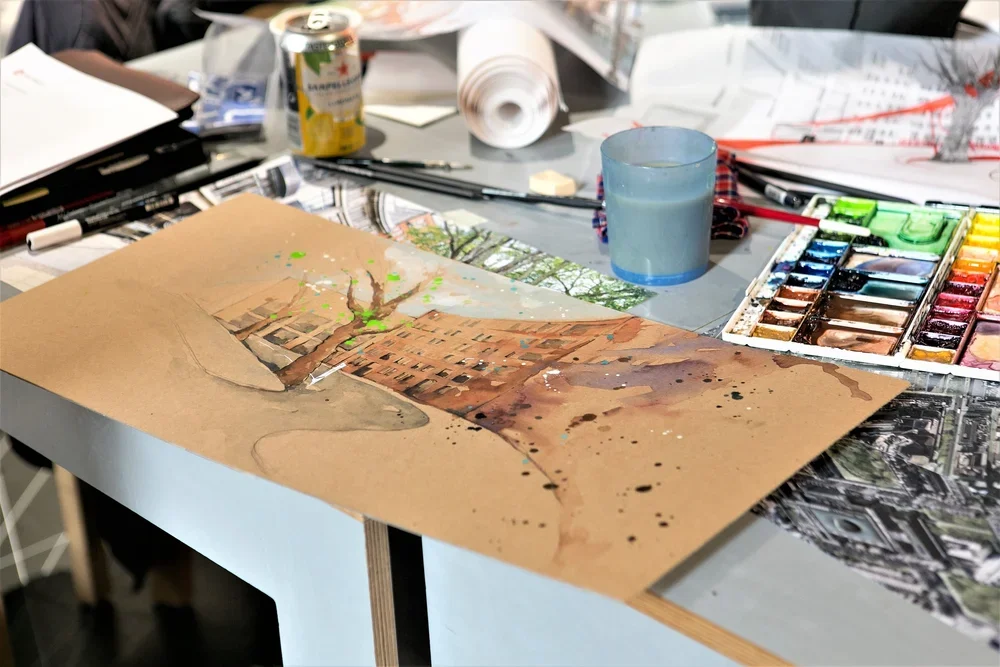
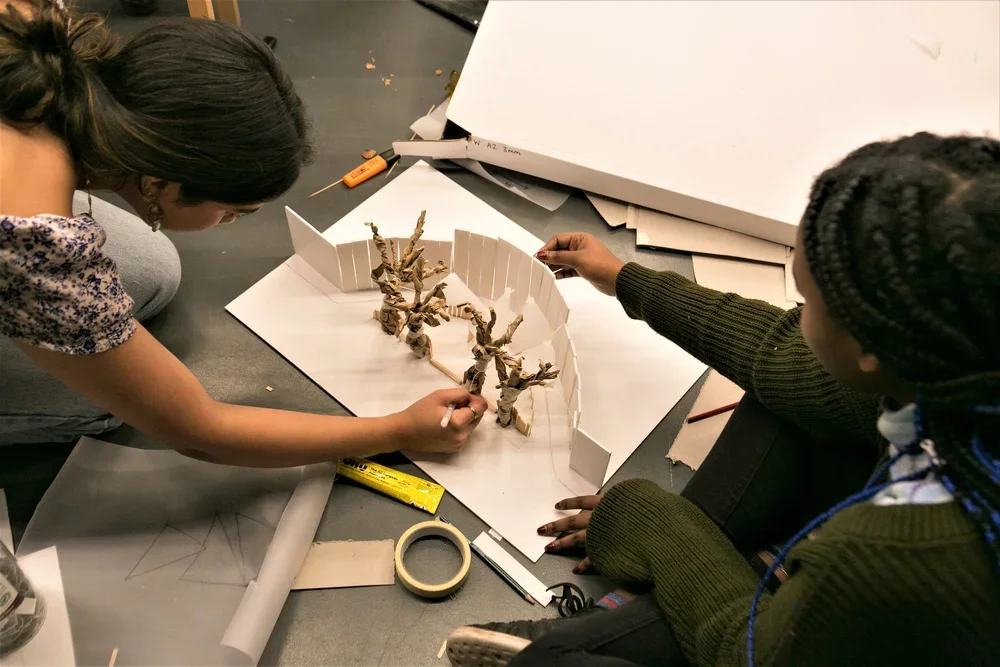
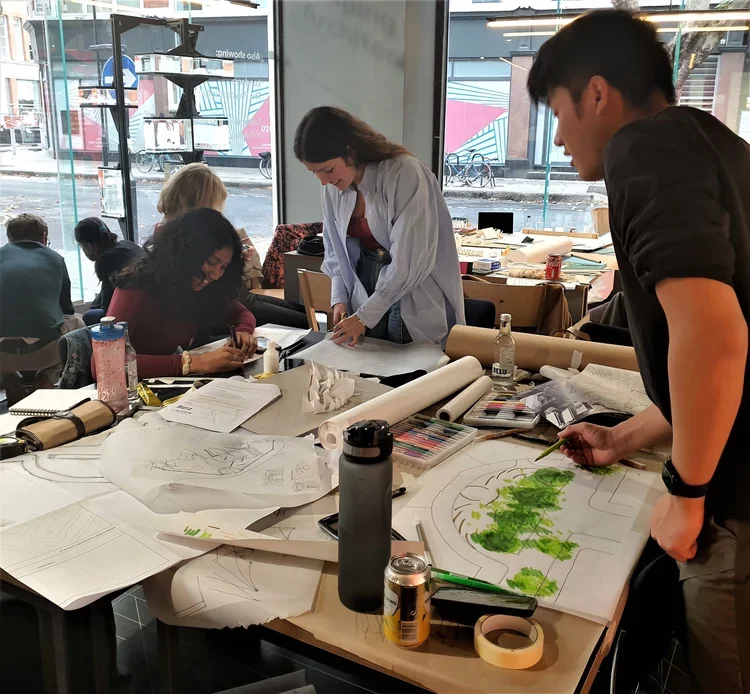
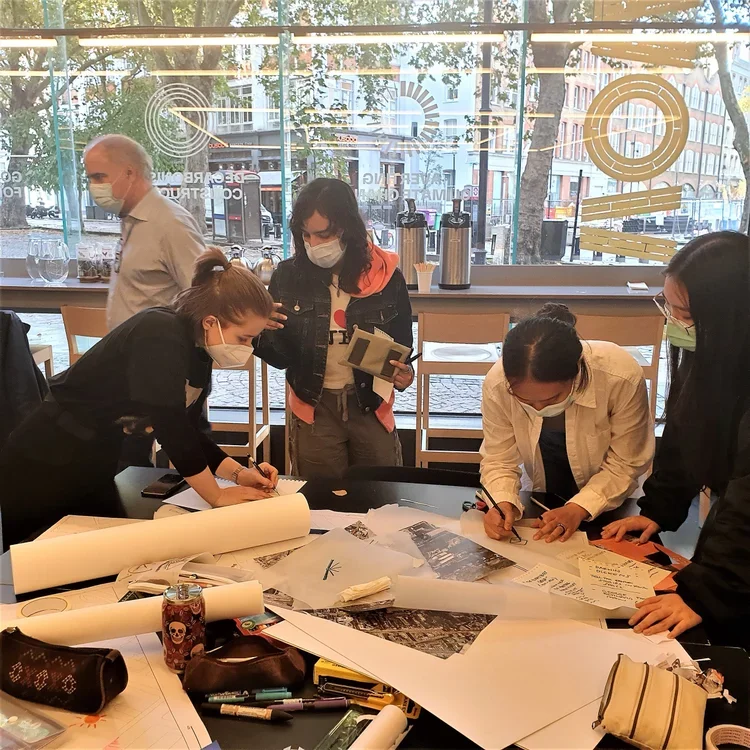
Photo: Students absorbed in their work... Credit: Agnese Sanvito
Peering apprehensively through the rain streaming down the windows of the Building Centre, the organisers of this year's Student Charrette started the day considering the very real prospect of a wash-out. Luckily, it wasn't long before they spotted the first competitors gamely wading through the sodden streets of Bloomsbury, to be rewarded with steaming cups of coffee and an endless buffet of pastries. As more students arrived for the day's competition, it became clear that an autumn downpour and early start were hardly enough to dampen the fires of competitive architecture, and this year's event saw a particularly strong student turnout representing universities from Dundee to Plymouth.
The day started with a presentation from Roca, the event sponsors, followed by an introduction to the competition brief. Given the Building Centre's location in Bloomsbury, the brief lent heavily on the area's literary heritage, using local resident Charles Dickens' A Tale of Two Cities to set the post-pandemic mood ('It was the best of times, it was the worst of times...'). The brief asked the students to design an intervention to draw visitors back into the heart of London and offered the small crescent in front of the Building Centre as the competition site. Prioritising a sustainable approach, students were asked to question how their structures might be disassembled and repurposed, and to carefully consider how they might use their interventions to express a broader vision for the post-pandemic city-centre.
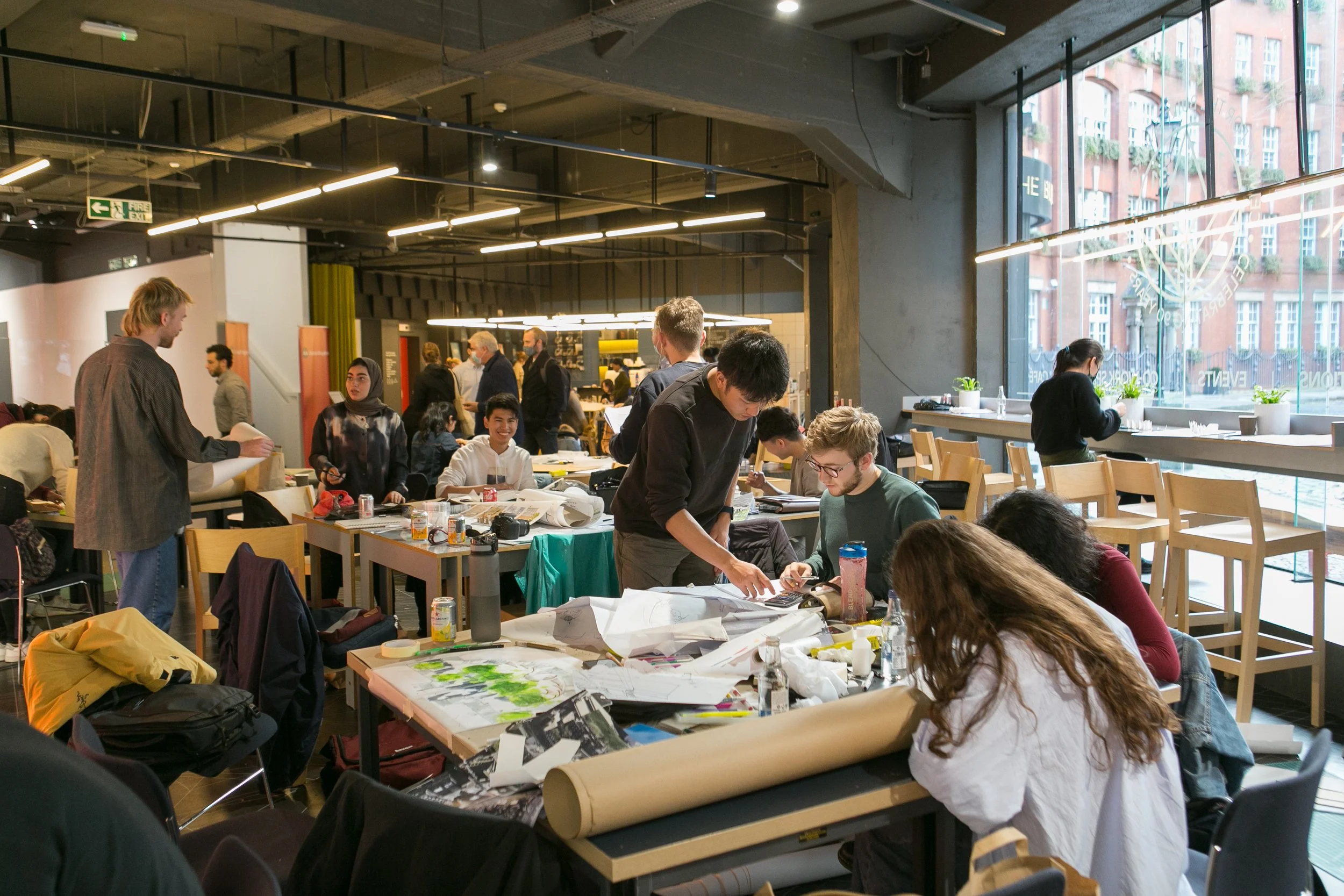
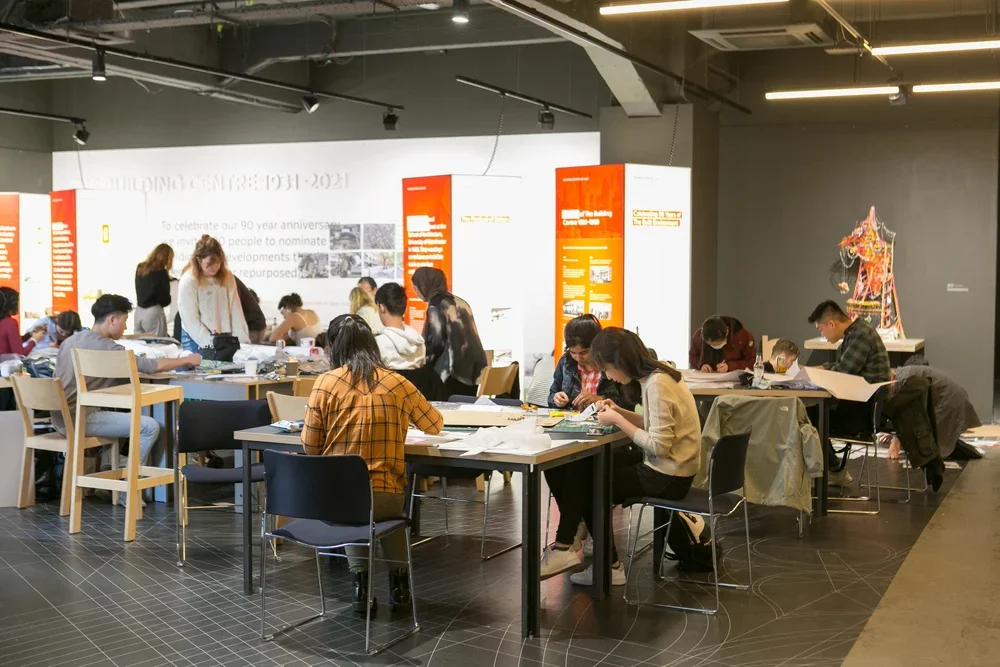
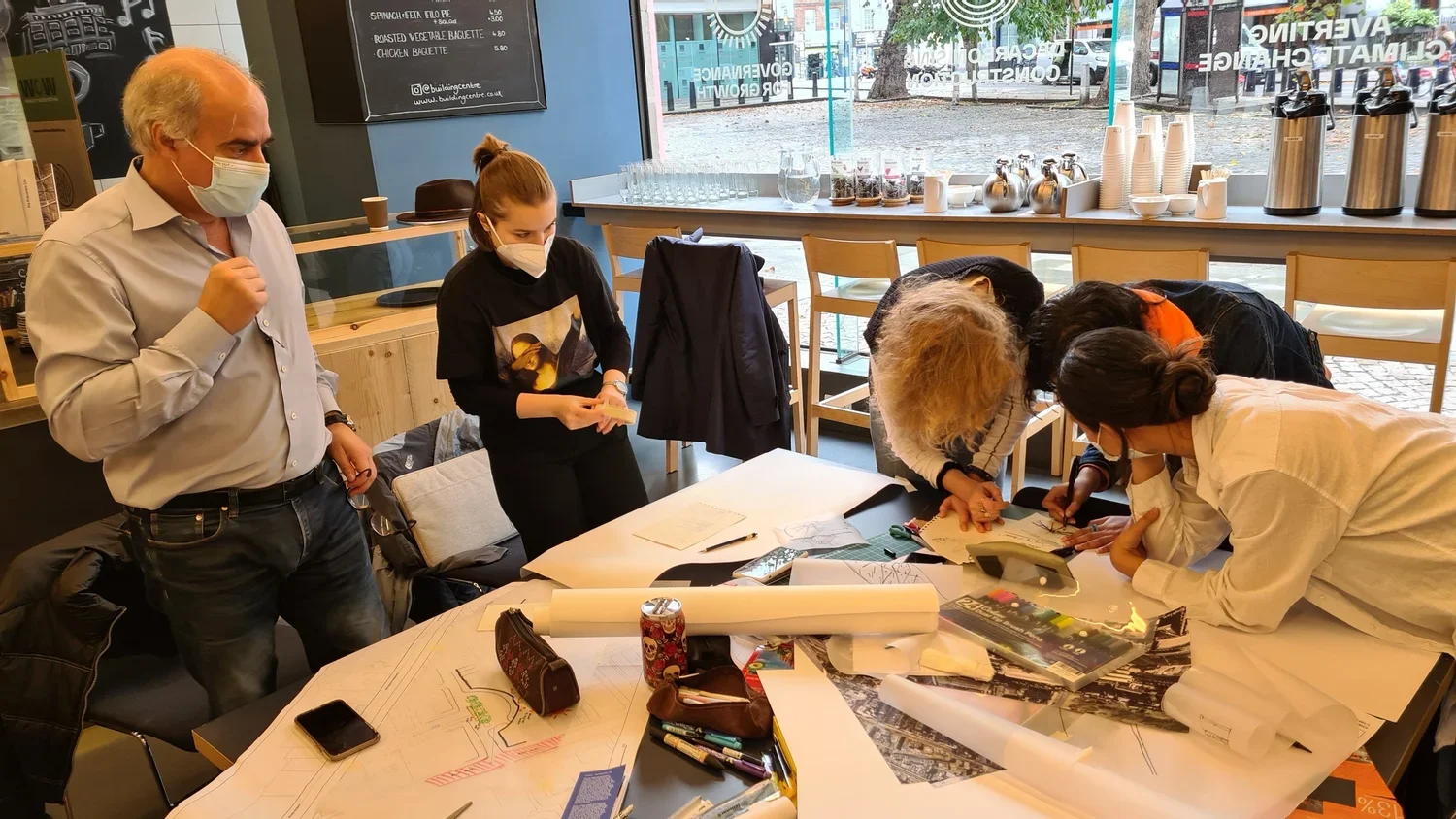
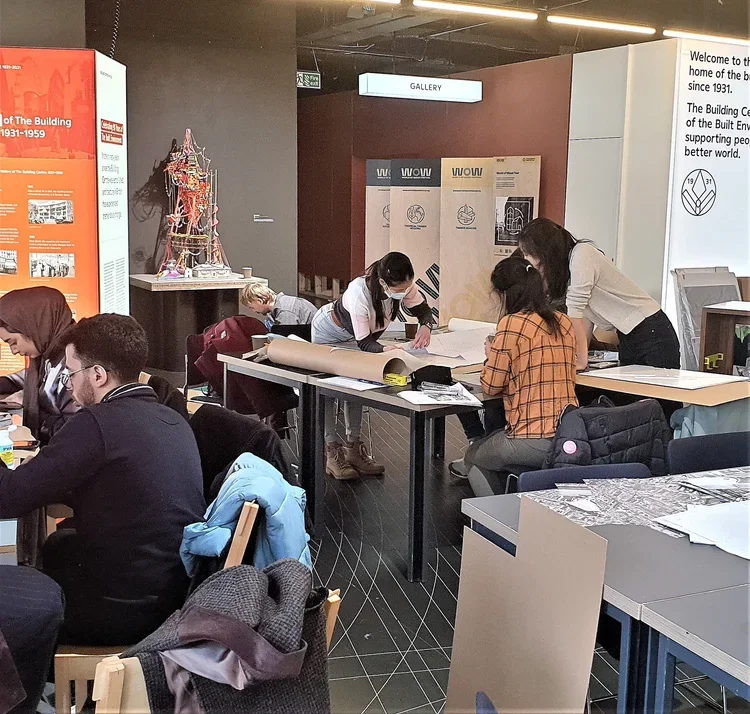
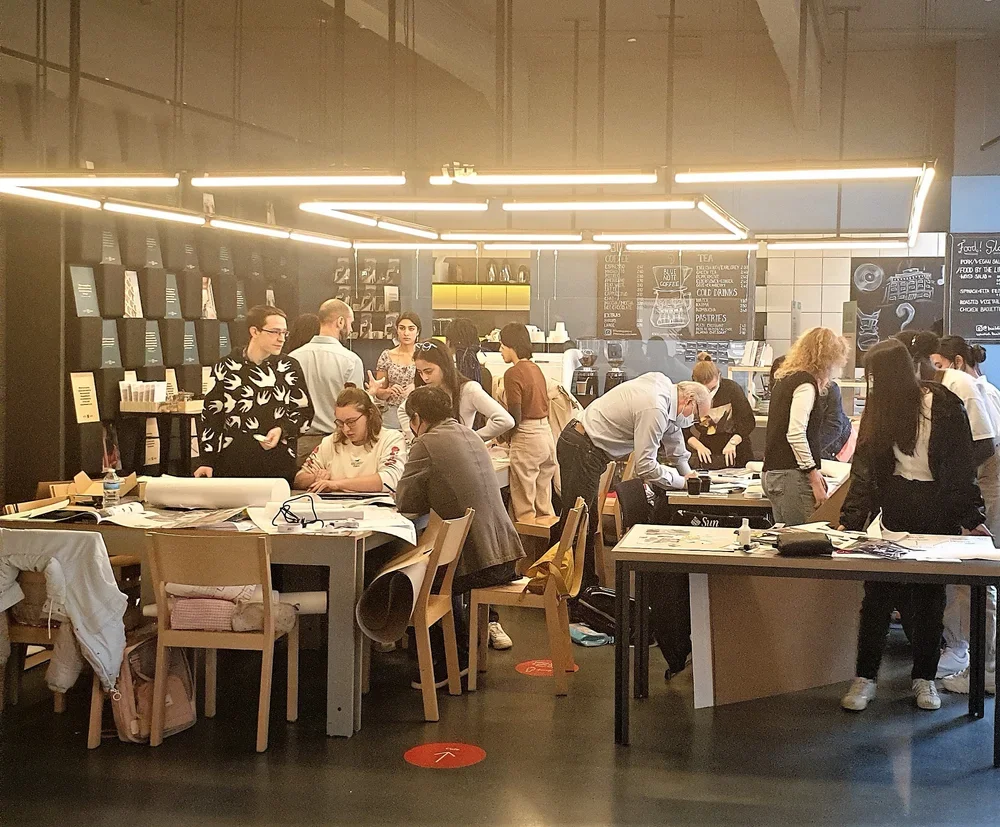
Photo: The Building Centre front show room and café, taken over by busy students… Credit: Agnese Sanvito
This year's charrette sought to ensure that all students who wished to take part could do so with minimal financial burden. In support of the Chapter's commitment to diversity and inclusivity, AIAUK provided students with all model-making and drawing materials, and a pre-printed competition pack of site-plans, site photos and elevations. Alongside the breakfast, lunch and drinks provided over the course of the day, there was also an offer to reimburse travel expenses where necessary.
After a frantic day of designing, the students presented their designs to a panel of three jurors, composed of Katharine Storr, AIAUK president and architect at AHMM, Rebecca Nixon, architect at AHMM and a previous winner of the chapter's Noel Hill Award, and Simon Aldridge, architect at Aldridge Atelier. Each team had five minutes to present their proposals and five minutes to receive feedback from the judges, who enjoyed a series of inventive and well-considered presentations from teams representing Hertfordshire, Bath, Nottingham Trent, Loughborough, Dundee, Reading, Ravensbourne, Westminster, Brighton, Sheffield, Plymouth, London South Bank, and the University for the Creative Arts.
Proposals ranged far and wide in their sources of inspiration and expression. The judges discussed musical installations, giant rope hangings resembling cobwebs, a furniture making factory-cum-street party, elegant mirrored and suspended sails, and a book exchange programme, before retreating to their chambers to determine the winner over a restorative glass of wine. During deliberations, students enjoyed their own, well-earned drinks in the Building Centre's gallery.
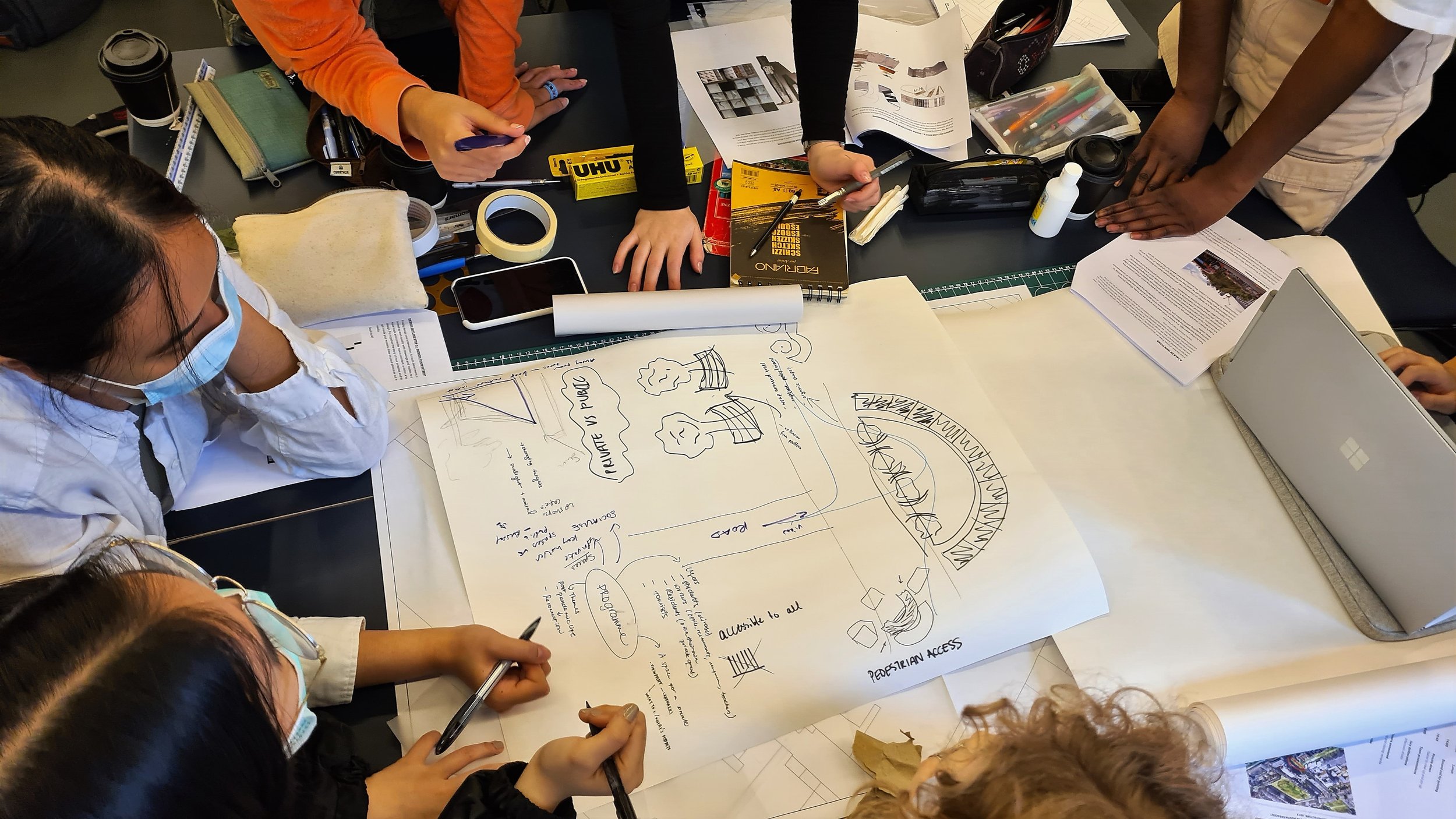
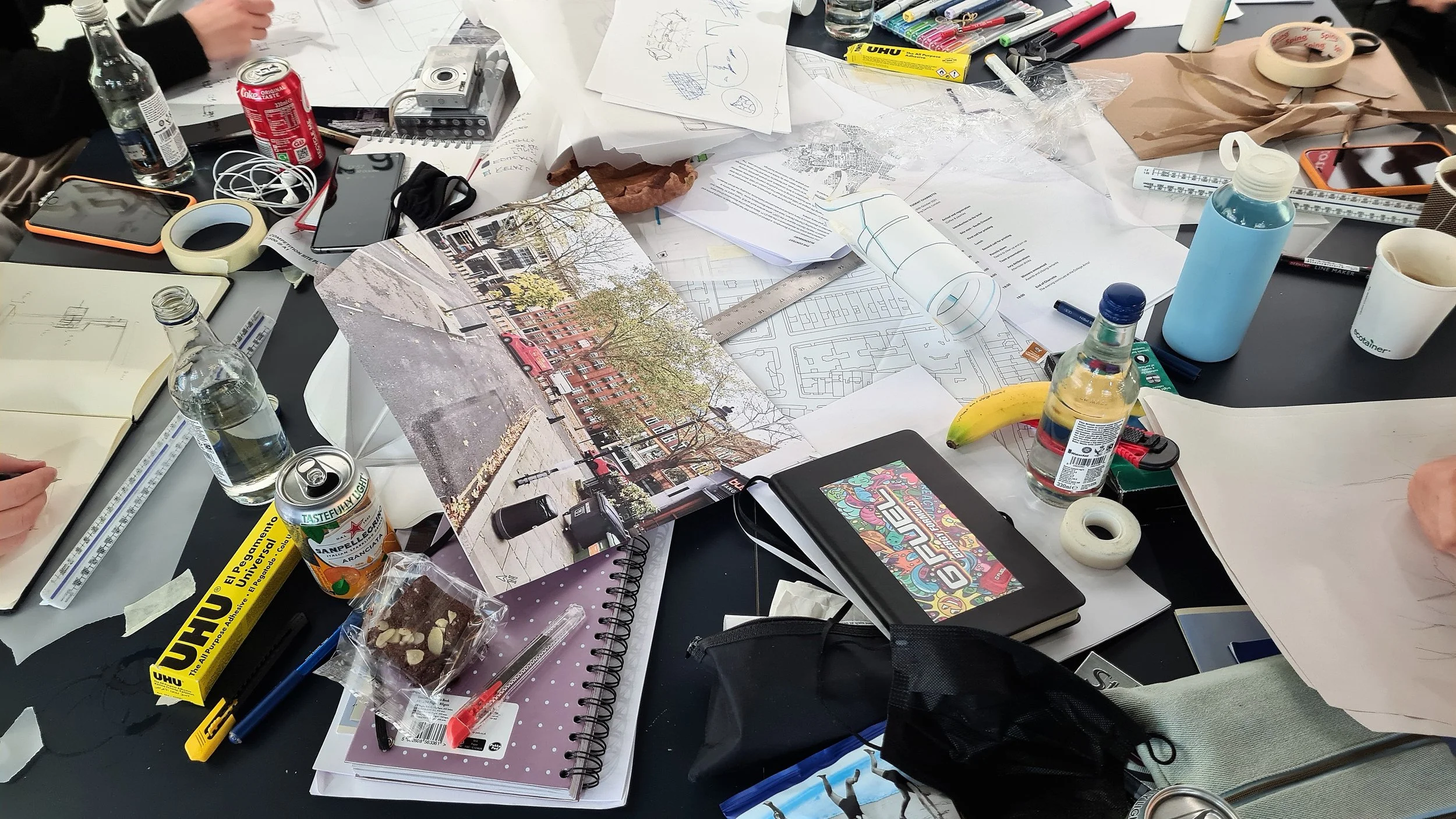
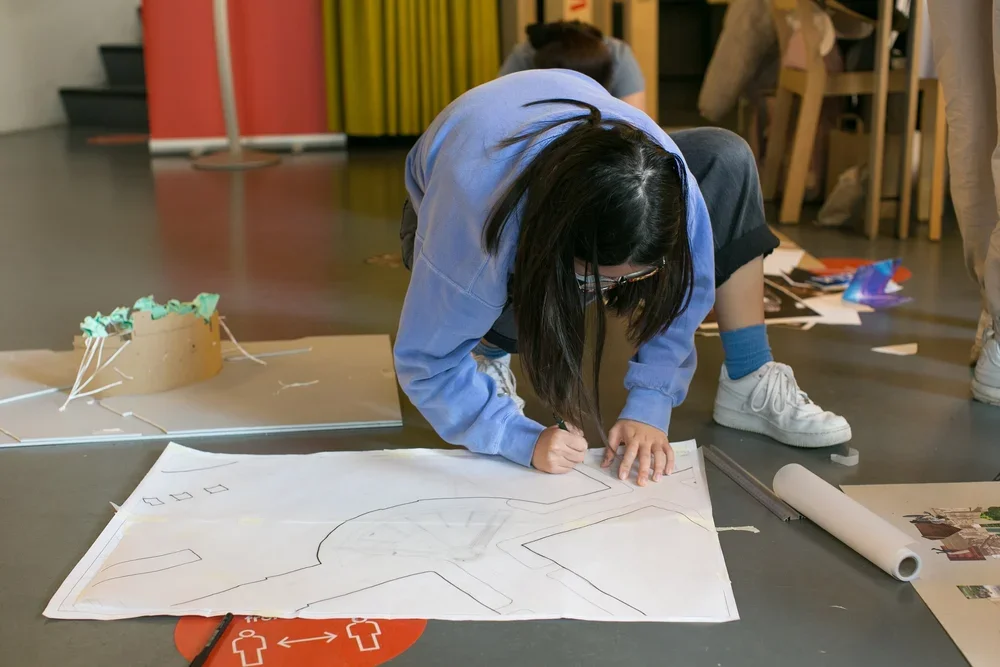
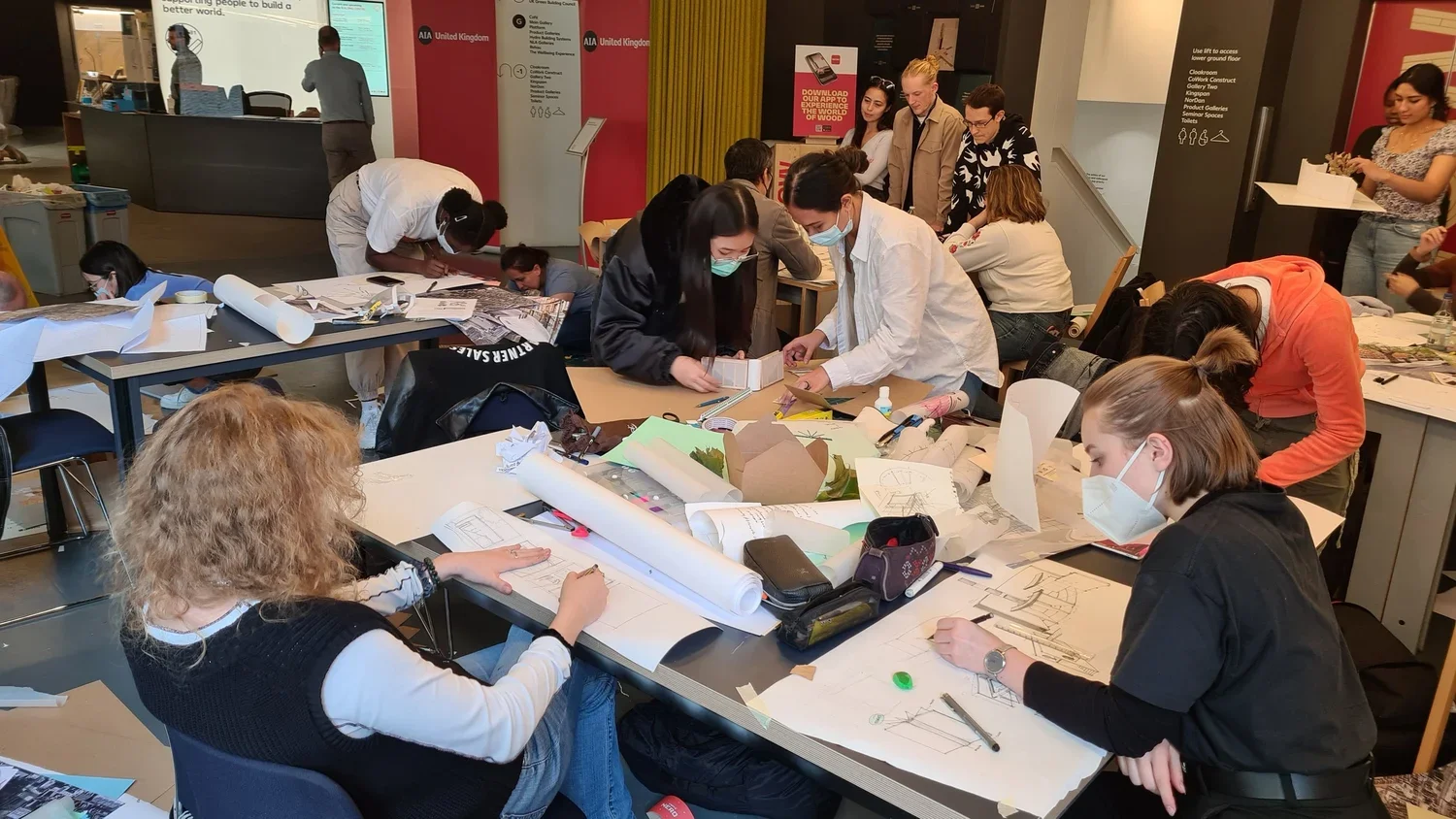
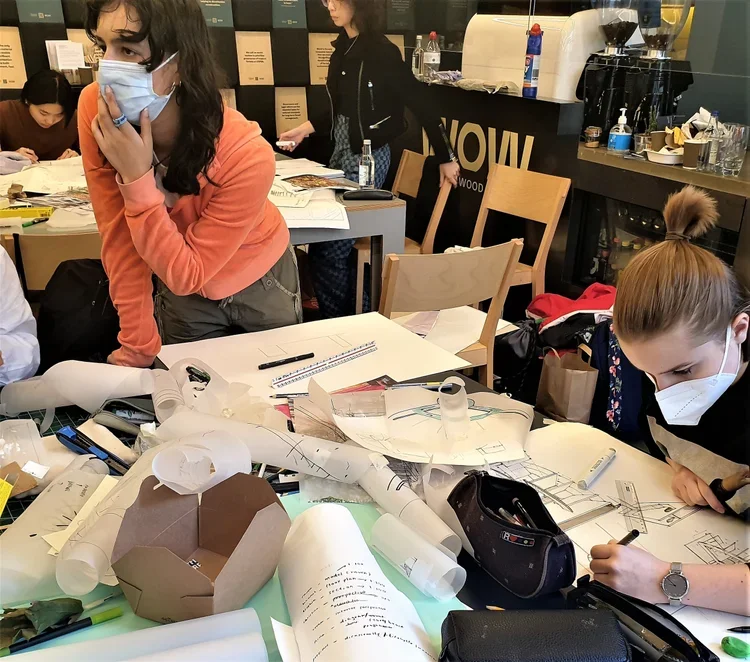
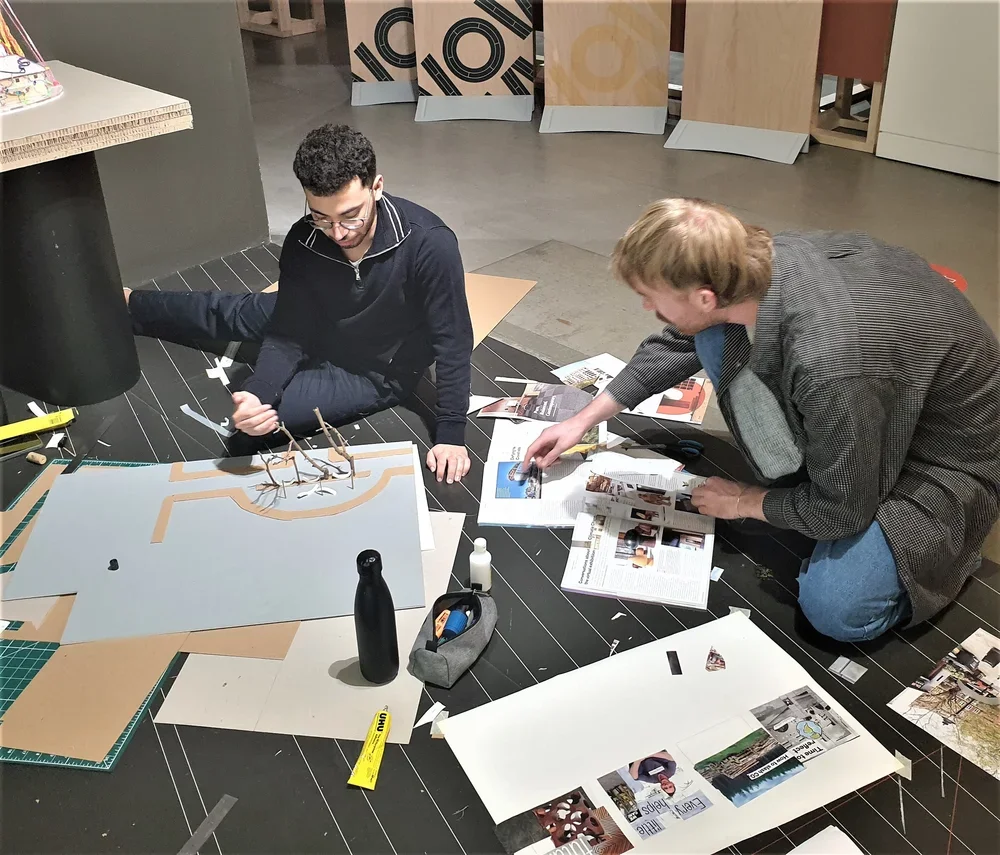
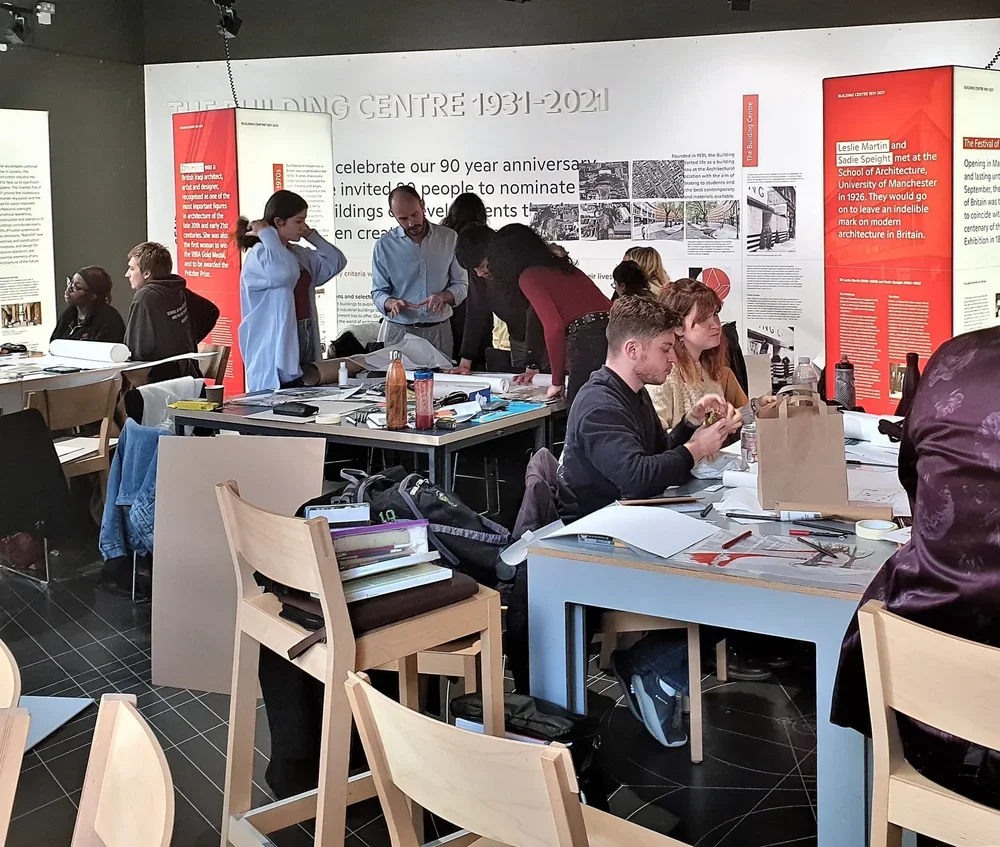
Photos: It was all about teamwork and a little bit of controlled chaos…
Finally, the judges emerged to declare the team from UCA Canterbury the winners for their whimsical proposal to line the streets of Bloomsbury with rain-powered music-machines. Having arrived at the charrette drenched, the students were able to turn their misfortune into an evocative starting point for their design process, which carefully considered how sound could be used to draw visitors into the heart of Bloomsbury. The judges felt they answered the competition brief successfully and praised the team for the sensitivity of their design and their vision for a city that celebrates its connection to the natural world and encourages visitors to think more carefully about their connection to site and climate. Runner-up prizes were also awarded to the teams from Bath and Sheffield for their community-focused proposals.
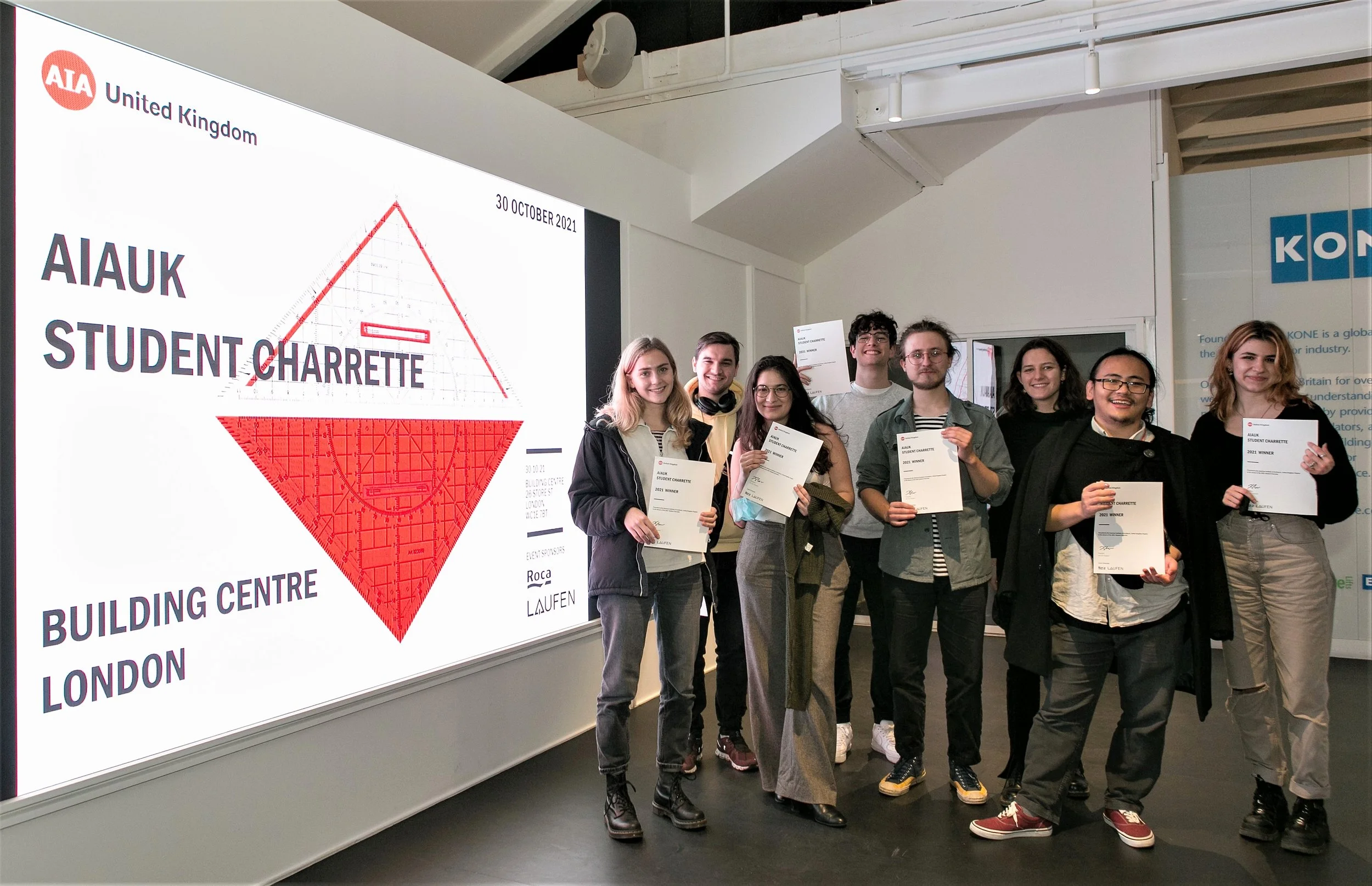
Photo: Congratulations to the winning students from UCA Canterbury: Kirils Bakirovs, Alfie Demmon, Ivor Gabric, Elena Gruber, Tancho Lawati, Mila Mielau, Alessandra Moraru, Dimitra Voutsi (mentored by Kevin P Flanagan AIA)! Photo Credit: Agnese Sanvito
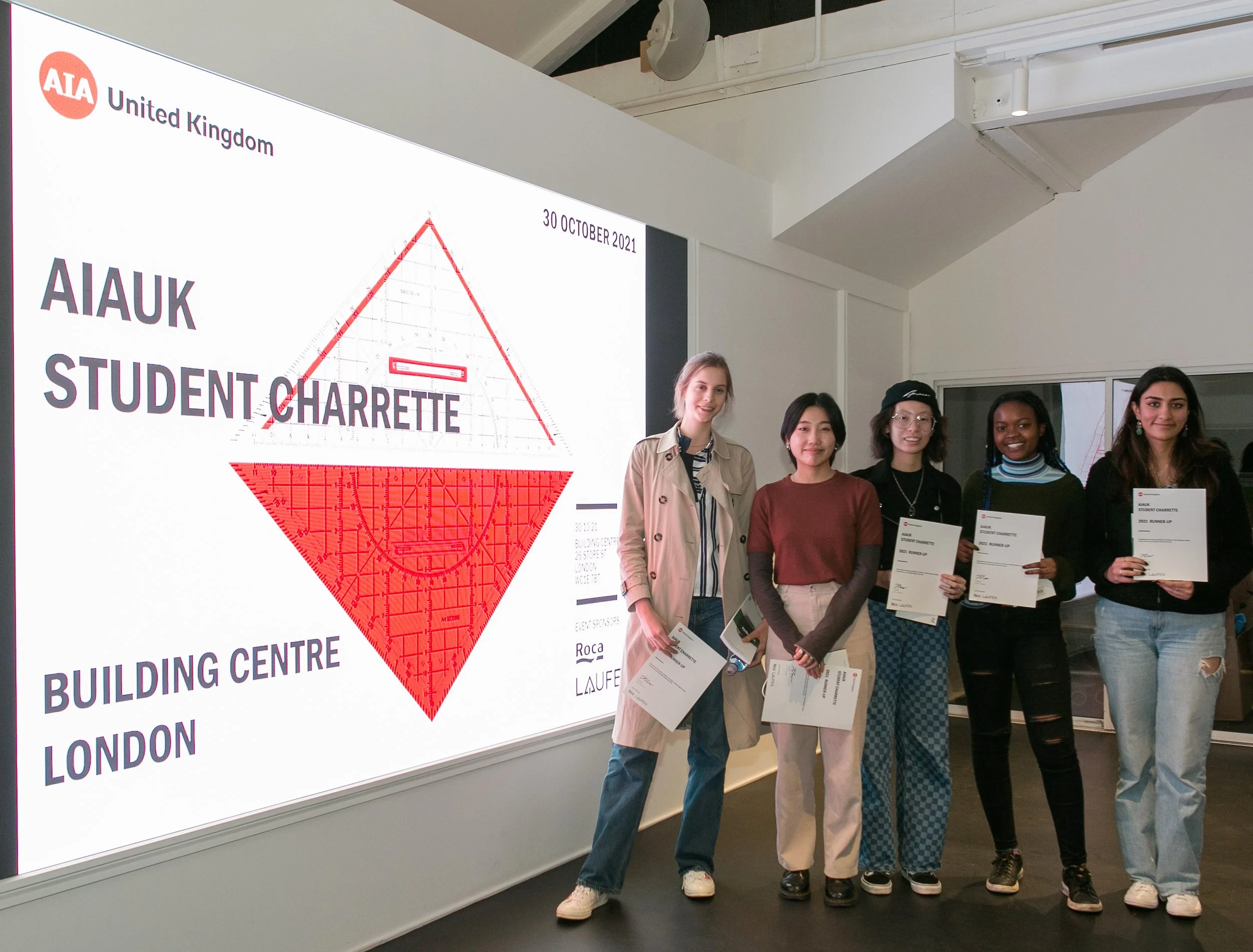
Photo: The runners up from Bath: Irene Mahanyu, Valerie Tsang, Zarhona Aslam Khan, Daria Shiryaeva, Cheuk Yan Ho and their mentors Matthew Heitel and Michelle Martin. Photo Credit: Agnese Sanvito
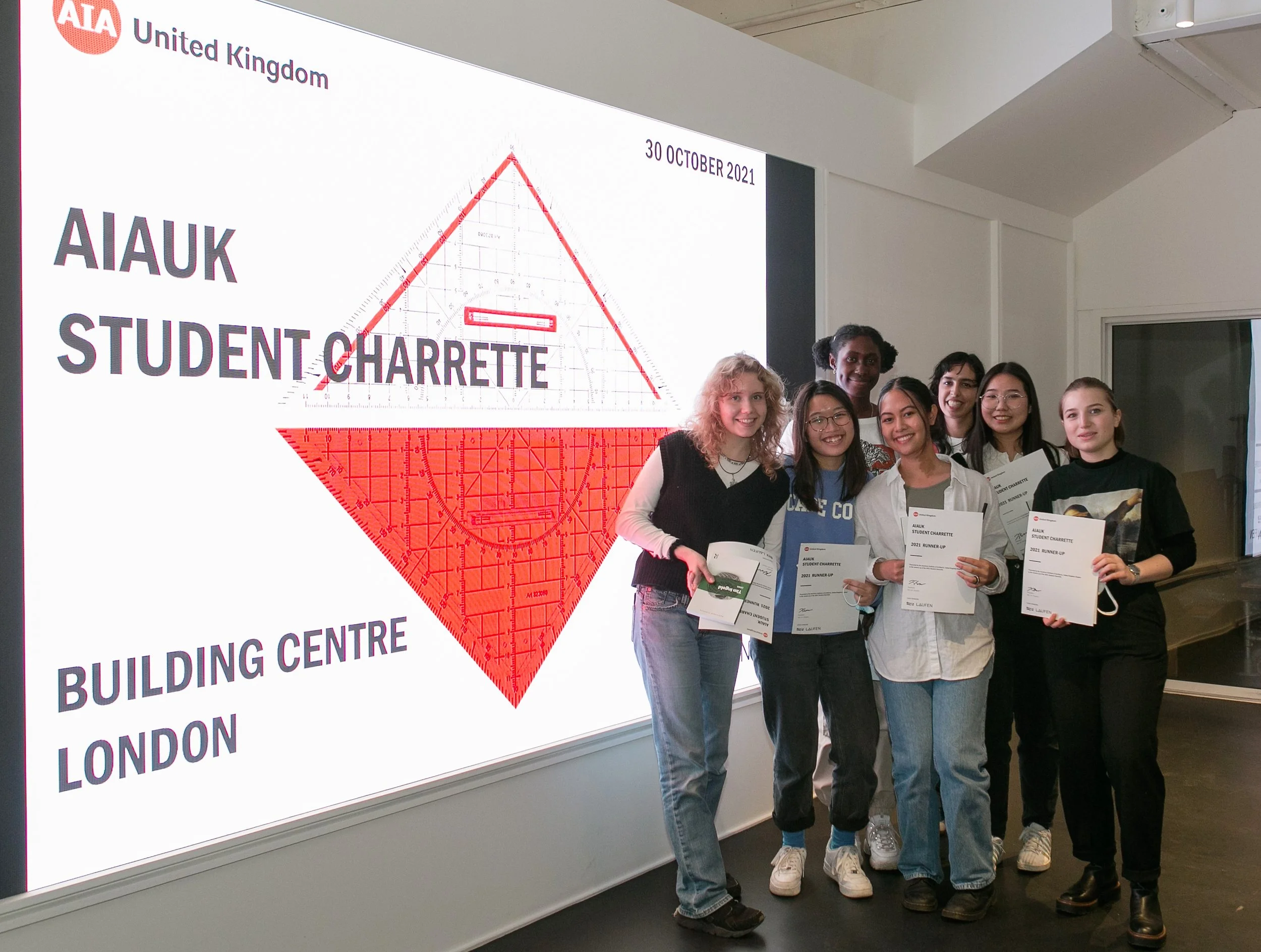
Photo: And the runners up from Sheffield: Francille Castro, Precious Obiyo, Hannah Chin, Cristina David, Nina Moisan, Sophia Hutchings, Nalinee Hanpiyavatanasakul and their mentor Pierre Baillargeon. Photo Credit: Agnese Sanvito
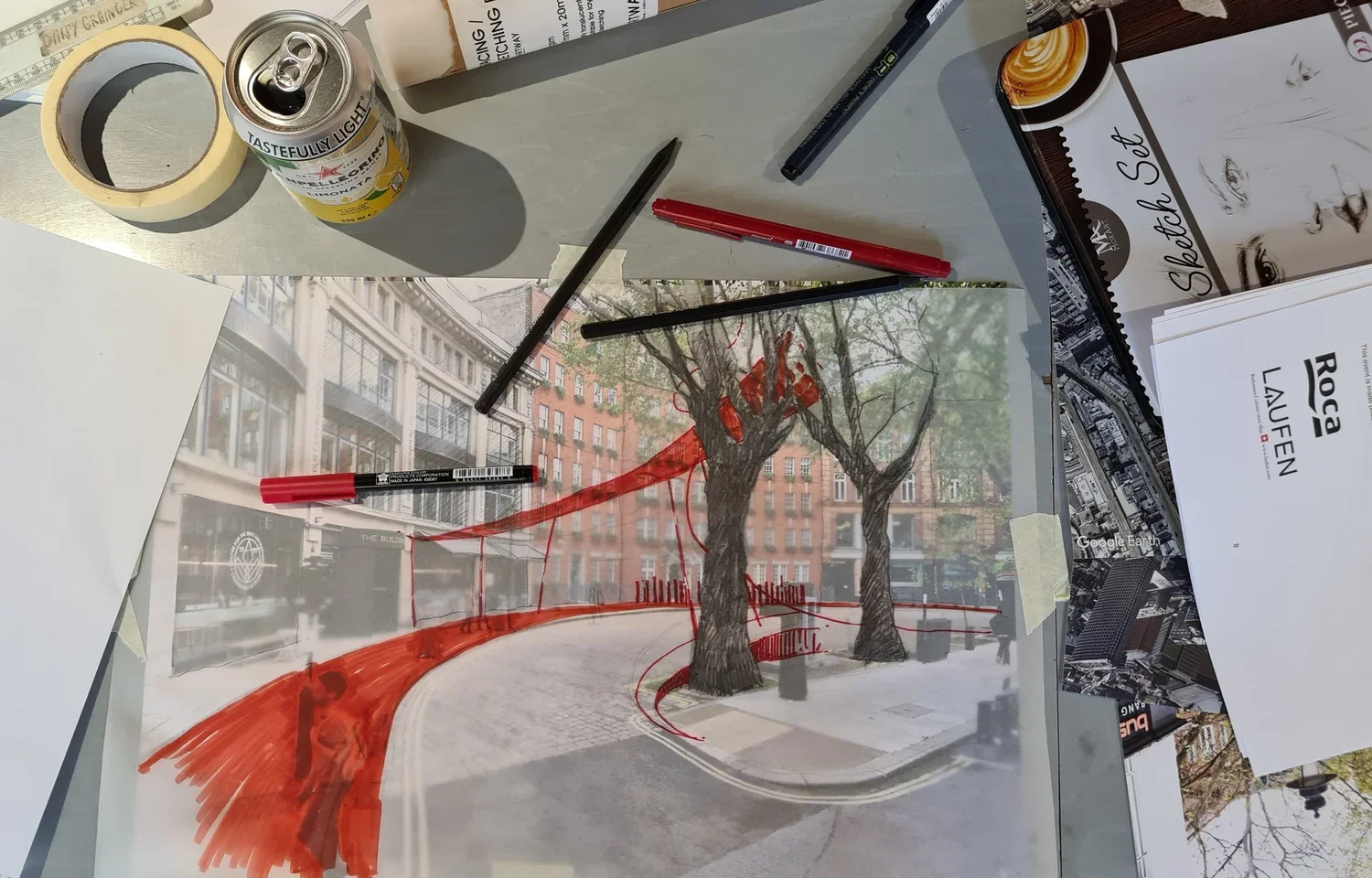
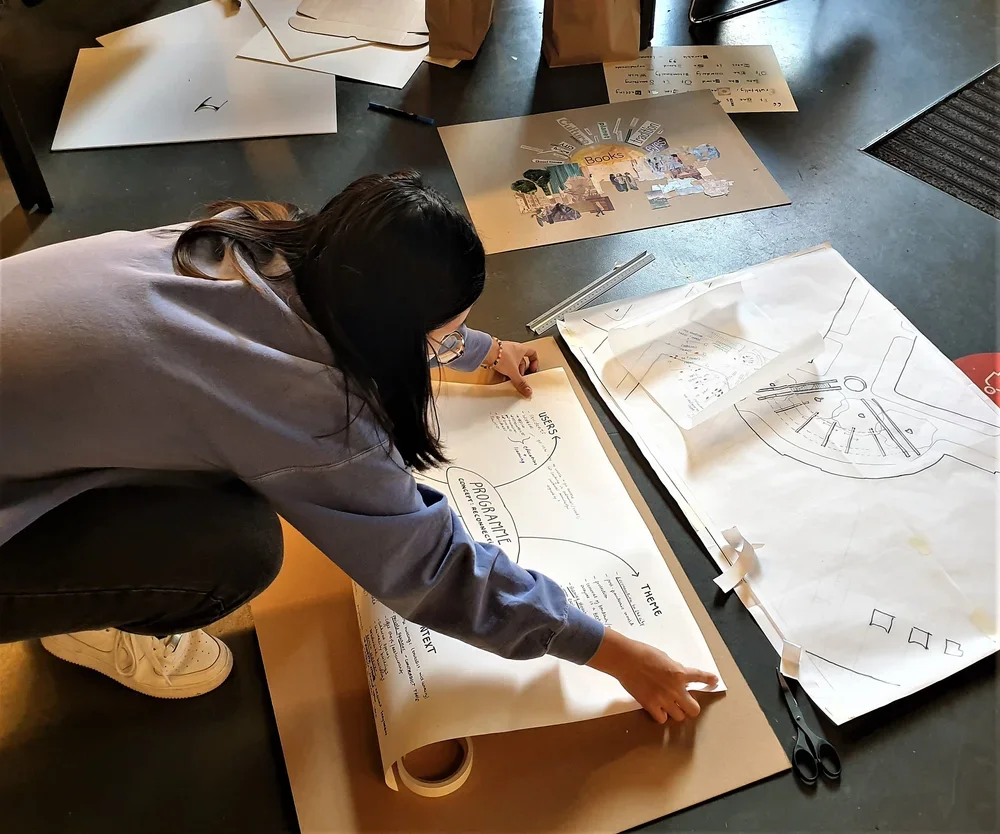
The charrette’s atmosphere of intense dedication and hard work is recorded in the slide show.

Written by: Nicholas Kehagias, AIA, RIBA
2021 Noel Hill Award Winning Team
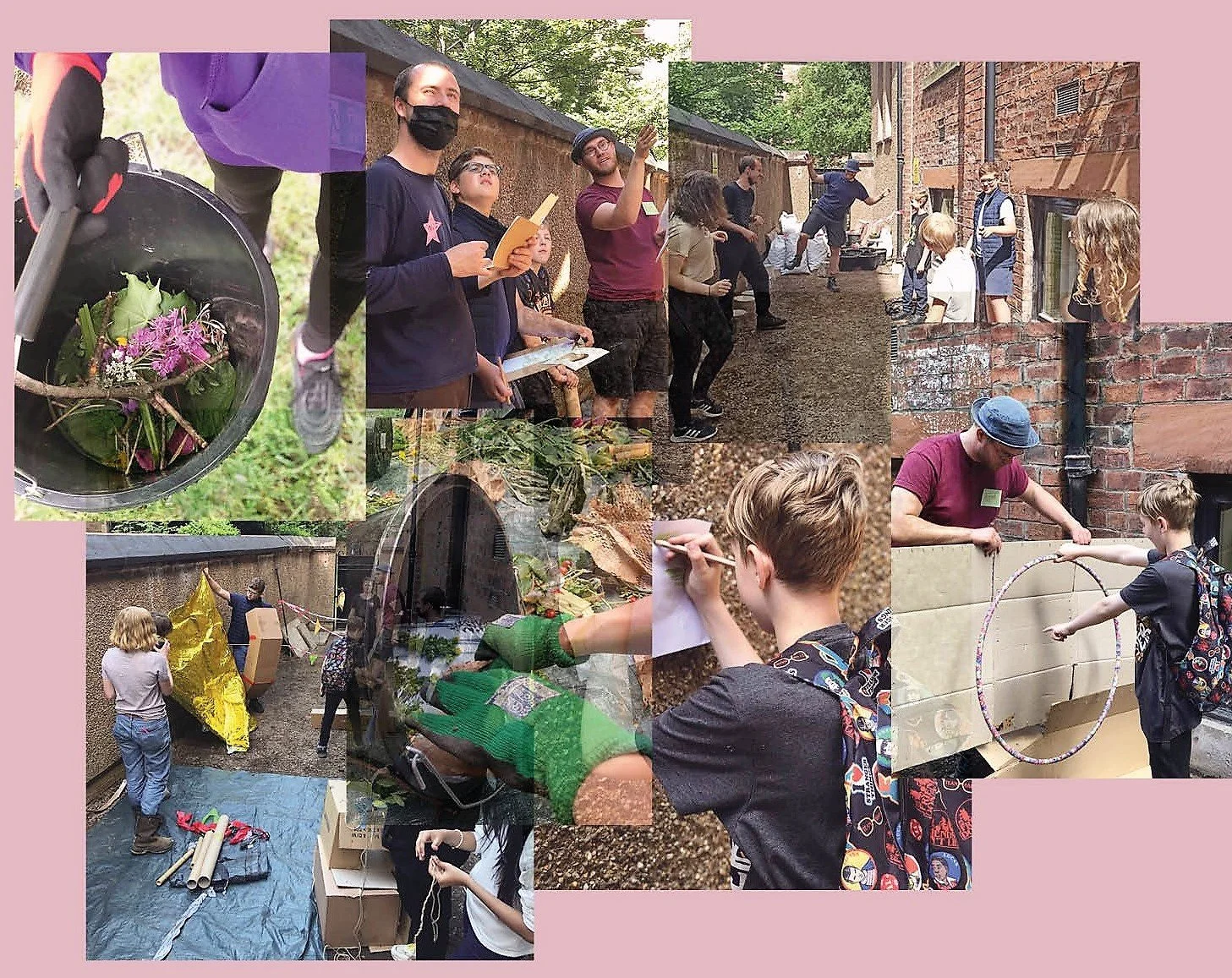
Photo: A college of the Mackintosh School of Architecture presentation.
It was a busy day for the Student Charrette jurors this year, as they met at the Building Centre in early November before that event to judge this year's Noel Hill Award submissions. The award is presented annually to a Part 2 student that has undertaken outstanding and original research during their studies. It is not limited by topic or location and offers £3,000 to enable students to further pursue and develop their interests.
Relaunched this year, the award attracted numerous entries, each of which consisted of two A3 pages and a short video presentation. Students presented their proposals for the continuation of research carried out during the course of their Part 2 studies, looking to win the £3,000 prize - one of the largest student architecture prizes in the UK. To learn more about the Award and the requirements see Noel Hill Award — AIA UK.
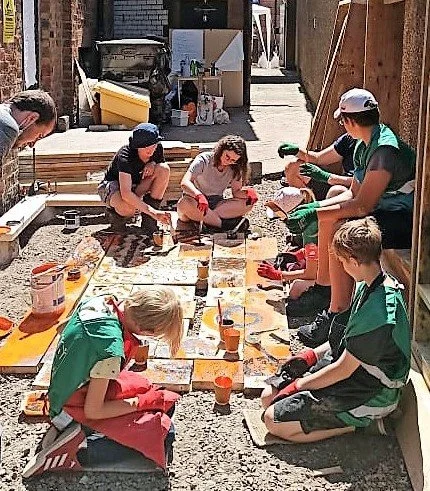
A team of four students from the Mackintosh School of Architecture were selected as the winners for their proposal to further develop a community-building workshop in the Govanhill area of Glasgow. The jury was struck by the participatory design initiated by the group, who showed resourcefulness and creativity in driving forward their community project during the pandemic. The AIA UK is happy to support their return to site for continued engagement - hosting new workshops, building further installations using recycled materials, and conducting post occupancy evaluations to gather feedback on their interventions.
Congratulations to the winning students: Lily Whitehouse, Kasia Antoszyk , Kester Samsom and Zoë Hyatt. We look forward to seeing how their research progresses over the coming year. Their completed research will be presented at the Chapter’s 2023 Excellence in Design Awards and will be published in a future newsletter.
Written by: Nicholas Kehagias, AIA, RIBA
Iris Ceramica invites AIA UK to the Architects Series at its Speakeasy Club
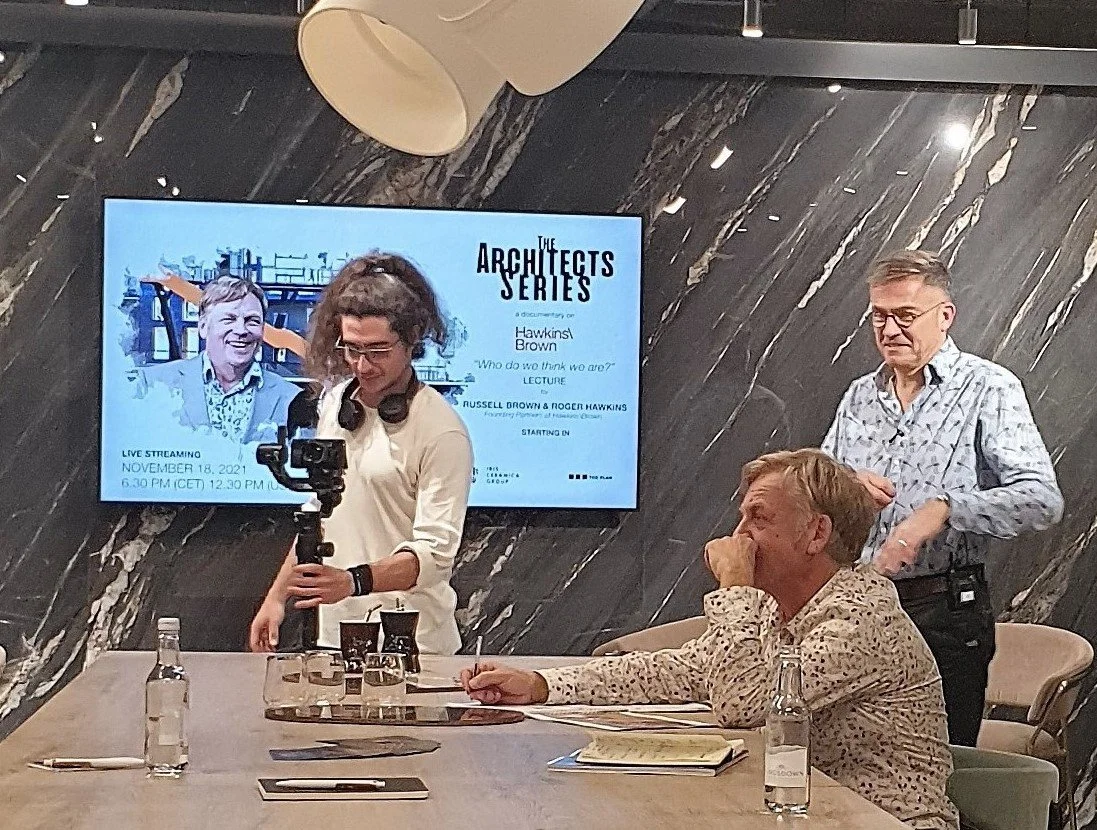
Photo: While Iris Ceramica’s production team set up the event, Russell Brown and Roger Hawkins go over their notes…
Following up on our commitment to become more actively involved with AIA UK Chapter’s sponsors, we were pleased to be invited to Iris Ceramica’s Speakeasy Club on 18 Nov 2021 for this month’s ‘Architects Series’.
The Architects Series offers exclusive videos - up close and personal - with some of the most famous architecture studios around the world. In collaboration with Iris Ceramica Group, team members from The Plan – an independent production team - go behind the scenes of the most important international practices to report on the life, work, and aspirations of the architects who build our cities.
The November session was an in-depth review of Hawkins/Brown Architects with a chance to meet the principles after the video for an open discussion of their work. At circa 300 employees, Hawkins/Brown is one of the UK’s largest architectural practices. Three major projects from the many reviewed in their excellent presentation exemplified the practice’s ethos of adding social value to good design:
Crossrail’s Tottenham Court Road station, emphasising art and circulation,
Sheffield’s Park Hill Housing, bringing ‘love, life and pride back to an abused icon’,
Olympic Park’s Here East project, rescuing a ready to be demolished broadcasting shed and turning it into 1.2million sq ft of creative and digital industry units.
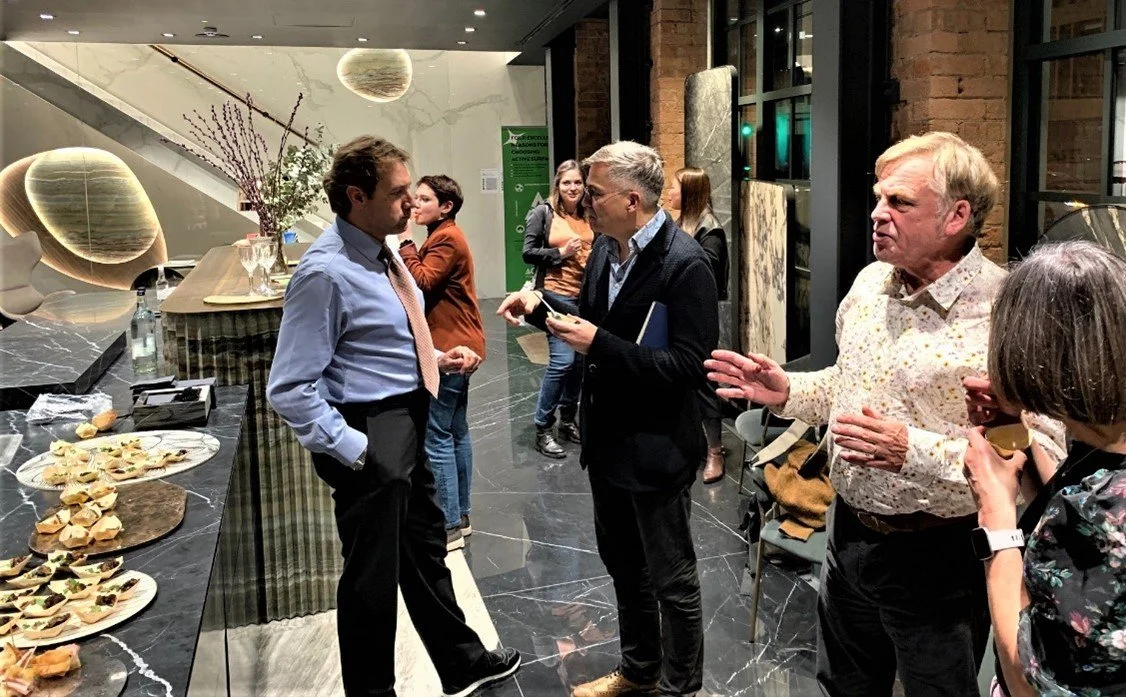
Photo: A relaxed atmosphere encourages face to face interaction with the featured architects.
Iris Ceramica’s Architects Series is international, and the event was transmitted simultaneously to London, Milan and Berlin with 2.0 CE credits for both the AIA and RIBA. Those of us attending live at the London showrooms witnessed the professional set up with a full production team and also enjoyed a classy after event bar (with canapes) - all imbued with high quality Italian design and panache. A relaxed and stylish way to earn CE units.
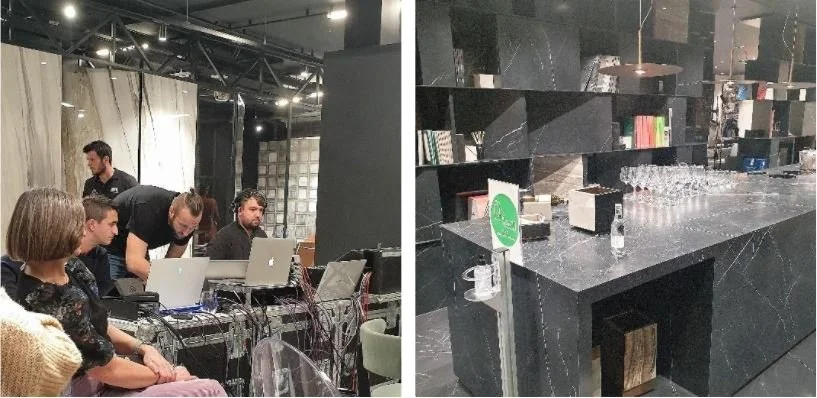
Photo: Iris Ceramica’s event was organised by The Plan, who handled the event logistics and continuing education requirements.
Another Speakeasy Club event scheduled for December will follow the same format as November’s offering and feature Wilkinson Eyre. Other AIA UK Chapter sponsors are also being considered as part of this initiative, including an upcoming lunchtime webinar hosted by Beale & Co.
Watch out for the official Announcement or check out our website ‘Events’ section for more details.
Written by: Lorraine King, AIA

65% by 2030 / ZERO by 2040: Top 200 Global Firms and Organizations Lead With 1.5°C Climate Actions
Panel Discussion from COP26 with Peter Exley, AIA President
Construction industry leaders, including AIA President, Peter Exley, show how it is possible for us to meet the 1.5°C carbon budget. They are drawn from the top firms and organisations signed up to the COP26 Communiqué, of which AIA UK is proud to be a founding signatory. Watch the panel discussion from COP26 here!
Description
By showing what's possible, we’ll embolden governments to do the same. The top 200 firms responsible for a significant portion of construction worldwide present the bold actions they are taking to decarbonize the built world in order to meet the Paris Agreement’s 1.5°C carbon budget.
Speakers are a select group of dynamic senior leaders from the signatories of the COP26 Communiqué. The signatories include the largest firms and organizations in the architecture/engineering/planning sector from around the world; the sector is acting on the urgency of the climate crisis.
Nanoparticles Used to Advance Ceramic Tile Technology!
Considering ceramic tiles have been utilized for millennia, you would think there is little room to make advances in the technology. You would be wrong! AIA UK members attended a fascinating lecture on a new technology utilized by the ceramic tile industry. The event took place on the 14th of October at Chapter sponsor, Iris Ceramica’s London Showroom.
Iris Ceramica developed and patented a technology that can be applied to most ceramic tiles. Nanoparticles of titanium dioxide are combined with silver and fired onto the surface of already manufactured ceramic tiles. This new line of tile is called ACTIVE SURFACES™. But why go to the trouble you might ask? Well, ACTIVE SURFACES™ exploits the photocatalytic properties of titanium dioxide and silver transforming the ceramic porcelain into an eco-active material with high end properties that are, antibacterial and antiviral, anti-pollution, self-cleaning, and anti-odour!
Considering the pandemic, the antibacterial and antiviral properties are particularly valuable. The silver content in ACTIVE SURFACES™ kills germs within seconds in a constant and everlasting manner. Another amazing property of ACTIVE SURFACES™ is its self-cleaning properties. This is particularly useful in public buildings where graffiti can be a problem. Realtime examples were presented to the attendees where dye was place on the tile and within 30 minutes it had faded!
After the lecture attendees were treated to a social hour featuring Italian food, wine and beer! To learn more about ACTIVE SURFACES™ and Iris Ceramica’s extensive line of quite extraordinary ceramic porcelain tiles, take a look at www.irisceramica.com. You are also, always welcome at their London showroom at 61-67 Old Street.
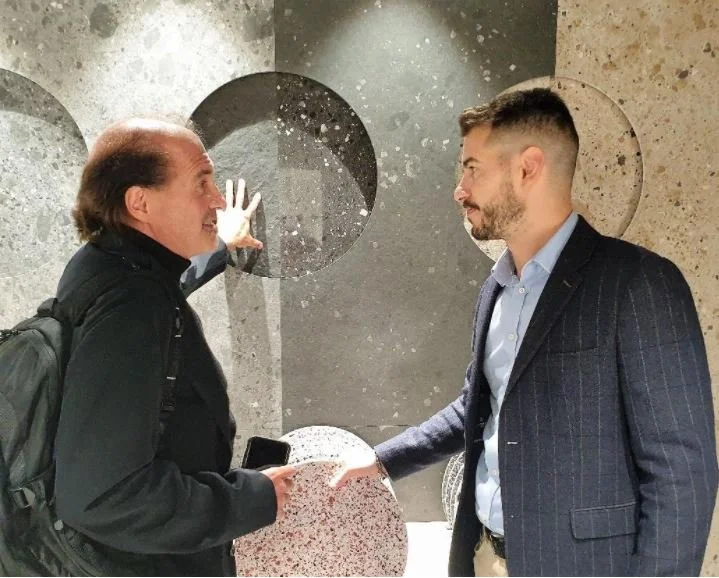
Chapter member Gregory Fonseca, AIA, (left) discusses tile with Giacomo Bertoni, Iris Ceramica’s UK Specification and Key Account Manager.
2021 Keynote Lecture Featuring Tatiana Bilbao
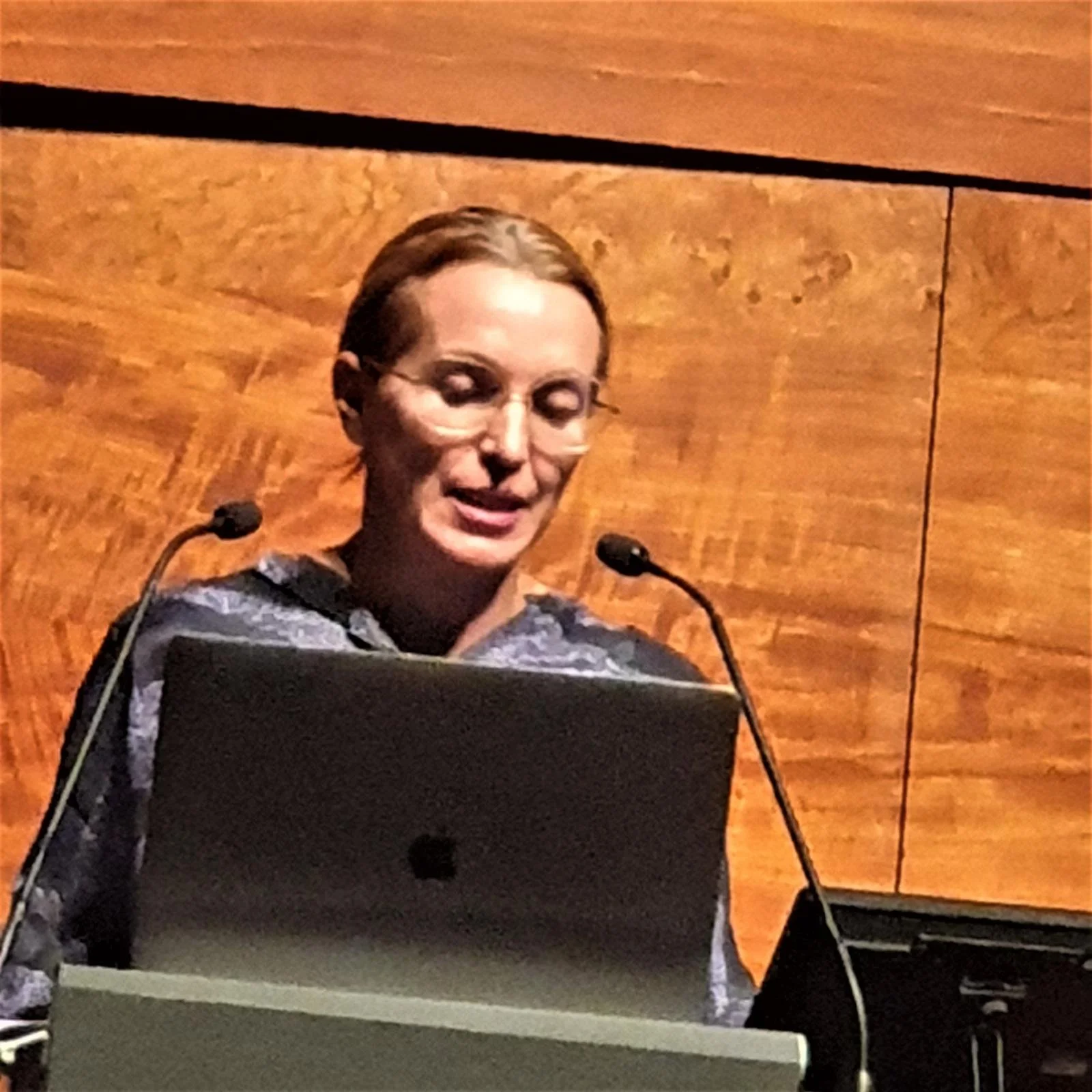
The 2021 Keynote Lecture Featured Mexican architect Tatiana Bilbao. The event was jointly hosted by the AIA UK and the RIBA, and it was held at the RIBA headquarters on September 27th. The event was the AIA UK’s first hybrid event, in that it was held-in person and simultaneously broadcast online. The evening was opened by welcoming addresses by RIBA President Simon Allford and AIA National President Peter Exley.
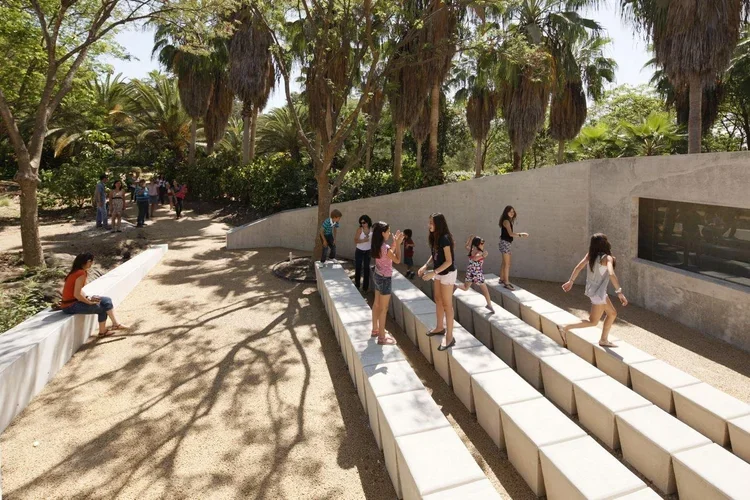
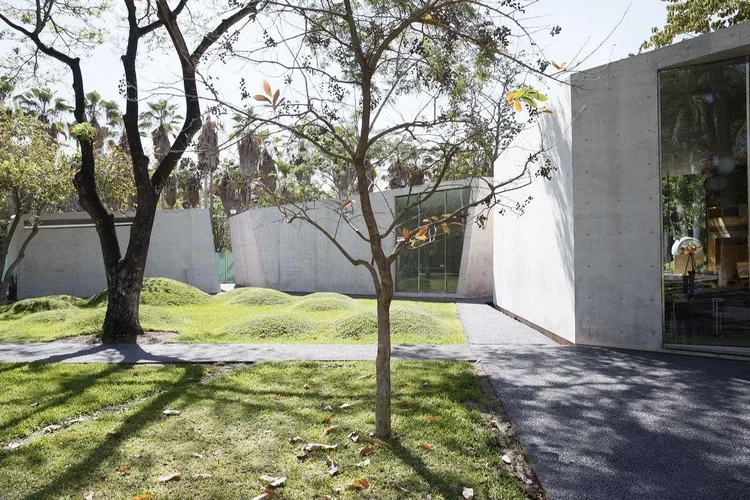
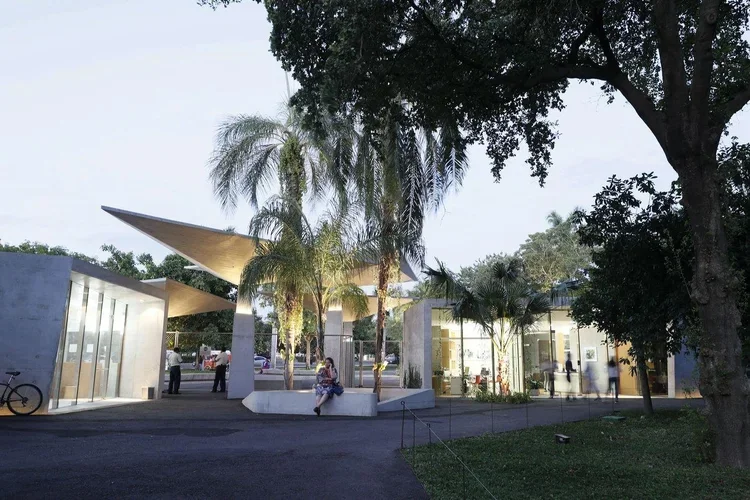
Tatiana Bilbao presented a range of her projects – from a botanical garden, an urban aquarium, a large university building, a Cistercian monastery, a community-based project designed around a San Francisco substation, and a house in Germany. The work is personal, bespoke, and carefully crafted to the client’s situation.
Interestingly, Tatiana Bilbao avoids the use of computer renderings, particularly in the early stages of a project. Instead, she has developed a unique ‘collage’ style of drawing that attempts to indirectly convey the essence of the project through an assemblage of disparate images. The collages are artworks in themselves.
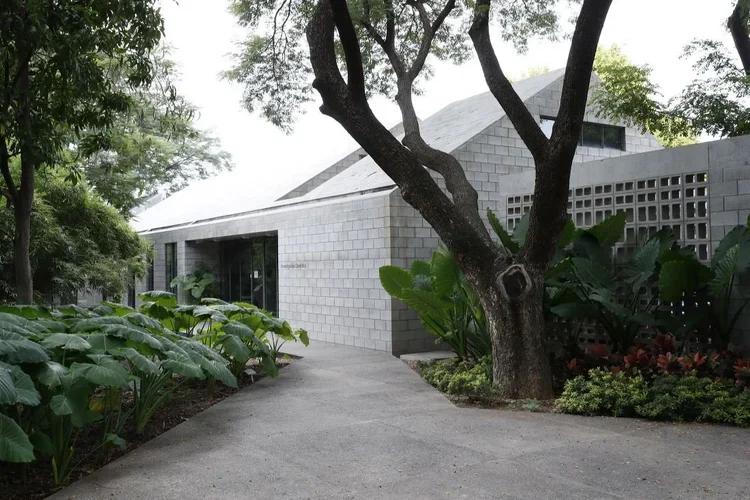
Tatiana Bilbao teaches at Yale University, and has taught at Harvard GSD, Columbia, and Rice in the US, as well as other universities internationally. She has been recognized with the Kunstpreis Berlin in 2012, was named in 2010 as an Emerging Voice by the Architecture League of New York.
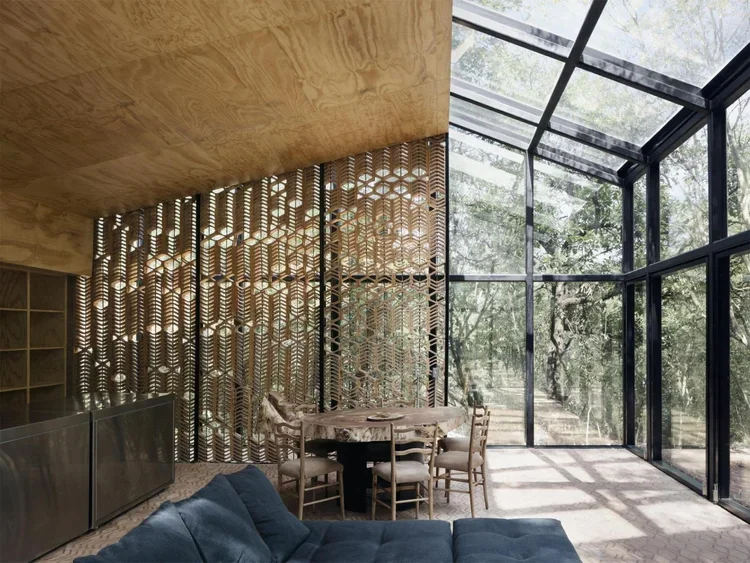
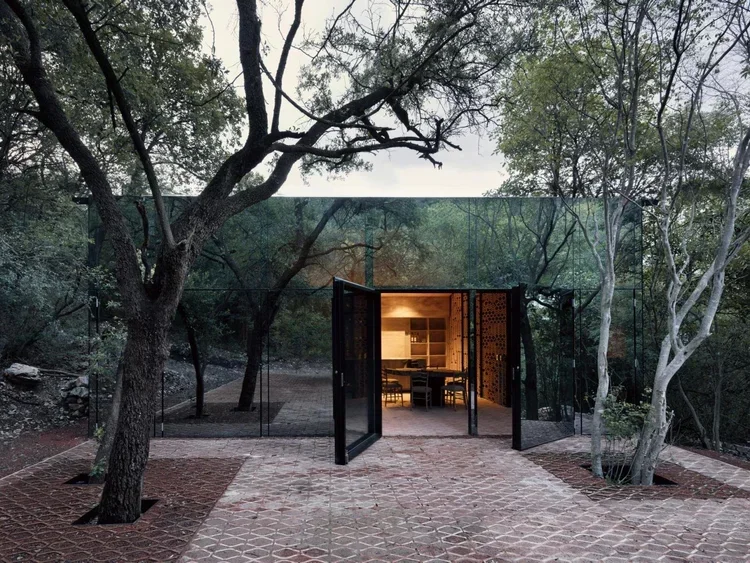
AIA UK President Katharine Storr, AIA moderated the event and hosted the Q&A. Drinks and canapes were served after the lecture.
The event was sponsored by Iris Ceramica.
Written by Lester Korzilius; FAIA, RIBA