

My MRA Experience - Etain Fitzpatrick on Perseverance

When I arrived in London, 20 years ago, the thought of becoming a qualified UK architect was the last thing on my mind. I had arrived onto an extremely busy project and was only meant to be here for six months and anyway I was already a registered architect in the state of New York.
However, fast forward seven years later, I was still in London and had decided that, as Lord Kitchener sang in the calypso classic, ‘London is the place for me’! I wanted to remain long-term and not being able to call myself an ‘architect’ in the UK while I was designing and delivering significant projects in London was frustrating, to say the least.
In 2014, I tried to get my Part 1 through the ARB Prescribed Examination process and for various reasons, ultimately, I failed. I was devastated, not only was it a humiliating experience, it was also very expensive! However, that didn’t deter me, I decided to get my Part 3 qualification. The course would help me with some of the evidence required for the prescribed examination and was ultimately required to obtain my UK qualification. I signed up for a Part 3 course at London Metropolitan University and I received my Postgraduate Certificate - Professional Practice in Architecture with Merit in 2015. Success!
Now back to the Part 1 prescribed examination….In 2017 I decided to take ‘Preparing for the ARB Prescribed Examination’, a short course at the University of Westminster. Yes, the prescribed examination is so complicated that there are courses to explain it. After the course, well, I procrastinated. I could never find the motivation to start the process for the Part 1 prescribed examination again.
In 2023, there was a glimmer of hope. The only good thing to come out of Brexit, a Mutual Recognition Agreement (MRA) between the UK and US architects was announced, at last! Hosted at the RIBA, leaders from RIBA, ARB and NCARB held a presentation followed by question and answers about the new agreement. I was buoyed! However, they were talking about requiring a UK Adaptation Assessment and I had my Part 3 qualification. I asked if I could use that in lieu of the assessment, but that ARB didn’t have an answer at that time. I followed up with the ARB by email afterwards and they said they were to discuss it at their next Board Meeting. I followed up again a few months later and the ARB confirmed that I could use my Part 3 qualifications in lieu of doing the UK Adaptation Assessment. I was one step closer….
However, another issue came up, New York State, where I am registered, was not participating in the MRA. Apparently, they were concerned about getting a surge of UK architects to NYC. Therefore, I needed to become licensed in a participating State. I reinstated my NCARB certification, became a licensed architect in the State of Pennsylvania (which included getting a set of fingerprints done for an FBI background check) then I used that license to apply for qualification at the ARB. The ARB then sent me a link to start my UK Adaptation Assessment, however, I informed them that I had my Part 3 qualification, which was fine, except, because I had received it over two years ago, I needed to submit my job description, a letter stating why I wanted to join the ARB register and list of two years of CPD. I submitted all the above and then in February 2025 I finally received my ARB registration certificate. After 20 years of working in the UK. I could finally call myself an Architect.
I need to run now, the first year of my ARB registration is due for renewal and I need to record my CPD. Cheerio!
Etain Fitzpatrick AIA NCARB RIBA ARB, a Director at JRA and is based at their headquarters in Southwark, London.
Written by Etain Fitzpatrick, AIA NCARB RIBA ARB
Preparing to take the Mutual Recognition Agreement Exam
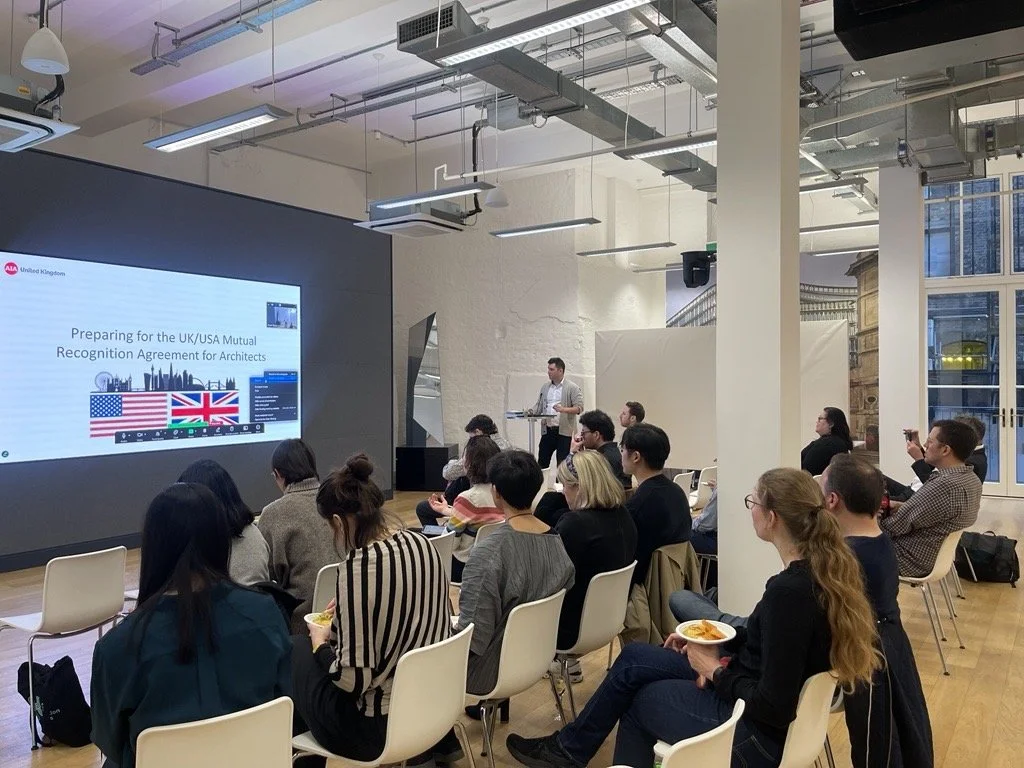
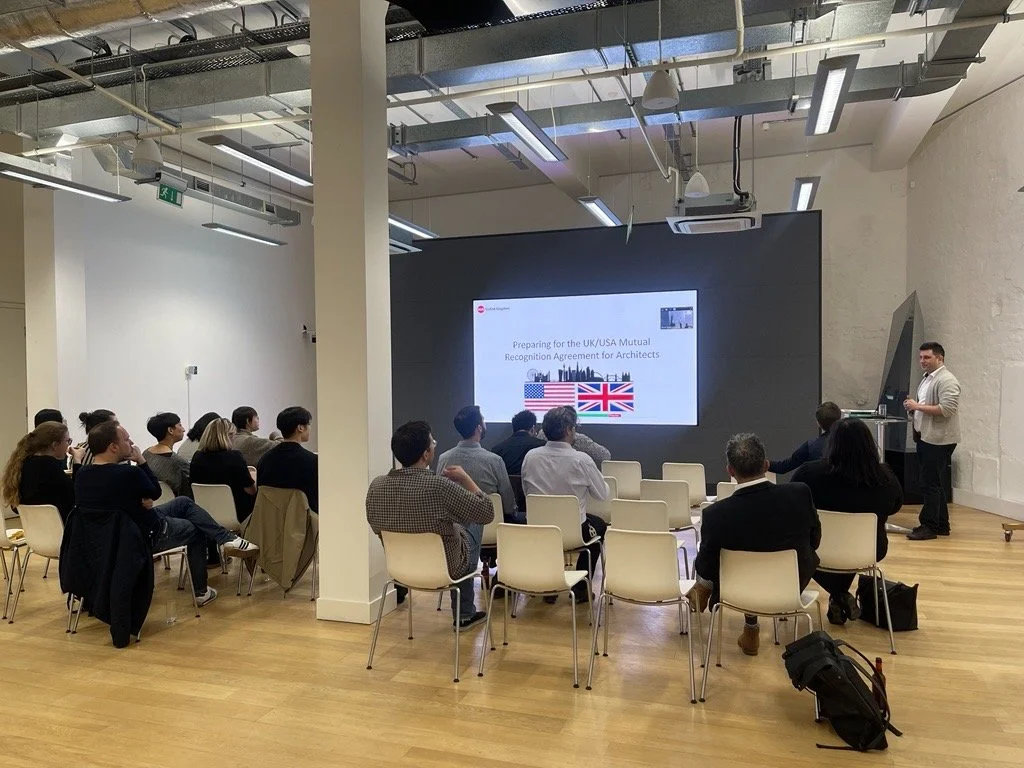
On Tuesday 8th April 2025 the chapter held a session on Preparing for the UK/USA Mutual Recognition Agreement for architects presented by Alex Miller, AIA RIBA and Bryan Oknyansky, AIA hosted at KPF architects offices in Covent Garden. The chapter has considered and campaigned for Mutual Recognition since its founding. Now with the process up and running as adminstered by the ARB, Bryan and Alex shared their experience as two of the early cohort to successfully pass the adaptation assessment exam. The event was well attended by practitioners at various career stages. We were appreciative that our guests included the attendance of Chris Williamson, RIBA, the 2025-2027 RIBA President.
While the ARB has refined the information available for candidates since launch including the Reference Sources Resource list, no study guide as such been available until now.
We trust the recording from this event and the slides from the presentation adapted as a guide assist future candidates seeking reciprocity.
Please find the event recording HERE and the presentation slides HERE.
Written by Alex Miller, AIA RIBA
My MRA Experience: Bryan Oknyansky on Licensure

Before the MRA, I was resigned to never being a qualified (equivalent to “licensed” as we say in the US) architect in the UK. I heard too many stories from skilled, talented and experienced American architectural professionals that started on the traditional 3-part UK Architectural Registration Board (ARB) path to qualification that ended with a lot of money and time spent only to be denied a qualification through an opaque determination process. And then, to this day, the only silver lining of Brexit is that the UK was able to negotiate directly with the US on reciprocity via the Mutual Recognition Agreement (MRA).
I was sceptical of this process as it was expensive and administered through the same organisation that administered the aforementioned traditional qualification process. I had a desire to be the, or one of the, first to become qualified through the MRA route. Alas, I waited to see how others faired before setting the costly process in motion. Eventually, after about a year had passed, I took the plunge and started the process to become the 14th applicant for qualification under the MRA.
At first glance, there seemed to be minimal criteria to submit information for consideration during the qualification process – a CV and a reflective career summary with specific references to learning outcomes and competencies found within appendices in the ARB qualification handbook. Given my past experience with the traditional 3-part qualification route, I felt I had to go above and beyond with the information I provided in response to the qualification requirements – better safe than sorry.
Eventually, a meeting was scheduled following payment of the MRA fee, a sort of pow wow with tribal elders, which is something I feel is more appropriate to gain an architectural qualification than a standardised test. The proctor’s requirement to make no indications as to how the meeting was going for the applicant notwithstanding, they wanted to get to know me, ask me about how architectural education and licensing works in the US, and learn that the professional and ethical values prized by NCARB are virtually identical to those prized by the ARB. It was great to be finally done with tip-toeing around the use of the title “architect” in the country I’ve come to call home for 14 years at that point.
Written by Bryan Oknyansky, AIA, ARB
My MRA Experience: Glenn Harmon on Licensure via the Mutual Recognition Agreement

I first approached the ARB in 2016 to see what options were available for becoming chartered given that I qualified in the early 1990s, was registered in eight states (all of New England plus New York and Pennsylvania), and held an NCARB certificate. I was invited to an interview at their Weymouth Street offices to discuss the process where I was informed that the ARB and NCARB were finalising a mutual reciprocity agreement and that it would go into effect shortly. In the event it was a few more years in the making, and I followed the progress closely as it rankled me no end that I couldn't call myself an architect when so many IT jobs were advertising themselves as 'solutions architects' or similar.
Once the legislation was through Parliament and received royal assent as one of the last Acts her late Majesty signed, it was still a year before the announcement was made at a joint conference held at the splendid Art Deco ARB offices in February 2023. All four professional organisations were present: AIA, NCARB, RIBA, and the ARB. I was in attendance and was probably in the minority in terms of interest of American architects seeking official recognition in Britain; most queries were about UK architects gaining US credentials. The big surprise was that not every state was participating, New York the notable exception to decline since practically every British architect was keen on opportunities there, so the discussion was centred on workarounds via the state reciprocity route. Interestingly, my home state of Maine was not on the list, but six out of the other seven I hold were, so it wasn't an issue.
The instant applications went live in April I submitted and jumped into the process. The materials provided on the ARB's website were useful, informative, and value for money. The most interesting aspect of the application to me was the Reflective Career Summary. I took quite a while sifting through my career path and composed a thoughtful document which was far more than a CV of quals and jobs. Quite apart from anything else regarding an educational or work experience standpoint, I think it was the summary of evidence which most clearly proved I am capable. Answering the scenario-based questions was also a good way of demonstrating my abilities because they required making assumptions about the information provided and the responses needed to remain consistent with those givens.
The last element in the process was the interview, held online, with three assessors who were articulate, impartial, and quite reasonable. It wasn't a formal grilling, more a conversation amongst professionals where they queried my experience within the framework of my scenario-based answers. The whole adaptation assessment process was really very smooth, and given I was the first candidate, glitch-free. My only gripe was the cost (just shy of £3,000), which seems a bit steep, although it is a one off and was never going to prevent me from pursuing. I joined the register and RIBA directly I passed the assessment, and I can now legally proclaim that I am indeed an architect - with no asterisk.
Written by Glenn Harmon, RIBA AIA-UK
NCARB & ARB SIGN ARCHITECT MRA AGREEMENT
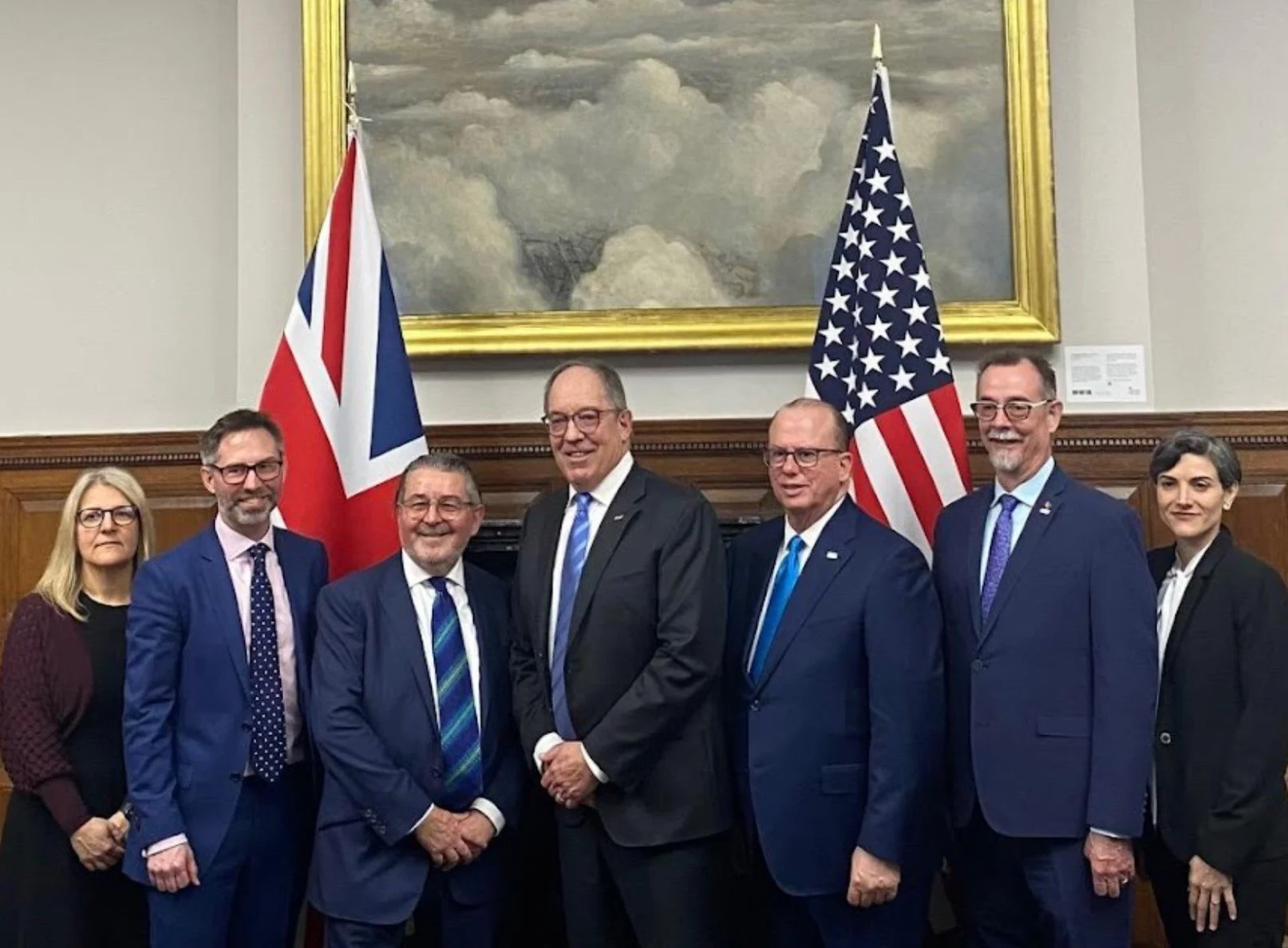
Architect registration board executives from the UK (left) and US (right) gather following the official signing of the agreement. From left to right: Emma Matthews (ARB), Hugh Simpson (CEO ARB), Alan Kershaw (Chair ARB), Bayliss Ward (President NCARB), Michael J. Armstrong (CEO NCARB), Harry Falconer, Jr. (NCARB), and Patricia Ramallo (NCARB). Photo by Adelina Koleva, AIA.
This article is part of an ongoing story; please refer to NCARB and ARB for the latest information.
On Thursday 16 February 2023, the landmark UK-US architect Mutual Recognition Agreement (MRA) between the UK Architects Registration Board (ARB) and the US National Council of Architectural Registration Boards (NCARB) was officially signed in London at the Old Admiralty Building Churchill Room. This transformative agreement will enable UK and US architects to practice internationally and benefit from shared knowledge and expertise.
AIA National President Emily Grandstaff-Rice, FAIA travelled from Washington, D.C. to attend the signing. From AIA UK, President Gregory Fonseca, AIA and Secretary Adelina Koleva, AIA were also present along with colleagues from the ARB, NCARB, RIBA, and government representatives from both the US and UK.
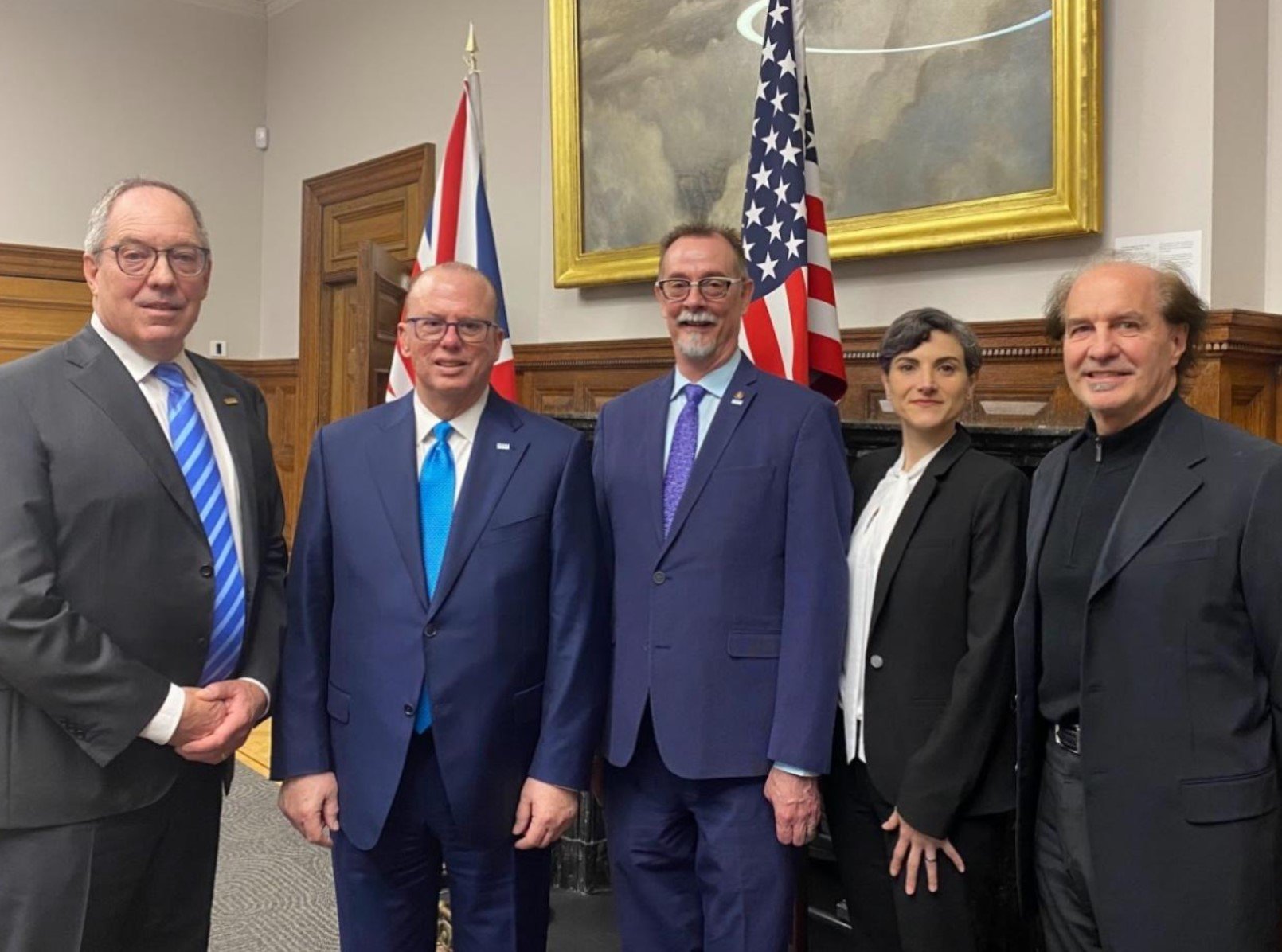
US architecture representatives pose with 2023 AIA UK President Gregory Fonseca. Pictured from left to right: Bayliss Ward (President NCARB), Michael J. Armstrong (CEO NCARB), Harry Falconer, Jr. (NCARB), Patricia Ramallo (NCARB), and Gregory Fonseca (AIA UK). Photo by Adelina Koleva, AIA.
In a request for comment, AIA UK President Gregory Fonseca has made the following statement:
The basis for the agreement is an acknowledgement of equivalency between the standards and qualifications set forth by ARB and NCARB. Such acknowledgement has grown from a longstanding relationship and shared esteem between US and UK architects, who regard one other as global leaders in architecture and design. The new MRA will therefore enable eligible architects in one country to register in the other, while still upholding the expected standards of practice that protect the public in all participating territories.
The signing of the agreement triggers the 60-day window for implementation. Starting on 25 April 2023, eligible MRA candidates will be able to benefit from a streamlined registration process that aims to reduce previously required costs and examinations. To that effect, ARB is launching a new UK Adaptation Assessment for US applicants applying through MRA routes. The assessment will be available those holding an NCARB Certificate holders who went through the Standard Path to registration (a process which typically refers to graduating NAAB-accredited professional degree programme, passing all required ARE divisions, and completing the AXP experience hours).
In the accompanying ARB press release, NCARB CEO Michael J. Armstrong and ARB CEO Hugh Simpson have been quoted with the following statements:

Michael J. Armstrong (CEO NCARB, pictured far right) discusses material of importance as Emma Matthews (ARB, pictured far left) leans in to listen. Meanwhile, Bayliss Ward (President NCARB, centre right) and Hugh Simpson (CEO ARB, centre left) contribute their signatures to the two copies of the MRA document as Alan Kershaw (Chair ARB, centre) looks on. Photo by Adelina Koleva, AIA
The MRA agreement is the first of its kind since preceding legislation was dissolved in the 1990s and represents new approach to registering international architects in the UK.
The AIA UK Chapter would like to congratulate and thank all involved in this initiative!
Written by Adelina Koleva, AIA
MRA Signing: Official Attendees
US Embassy
Rosemary Gallant (Minister Counsellor for Commercial Affairs - US Embassy)
US NCARB
Michael J. Armstrong (CEO NCARB)
Bayliss Ward (President NCARB)
Patricia Ramallo (NCARB)
Harry Falconer, Jr. (NCARB)
US AIA
Emily Grandstaff-Rice (President AIA National)
Gregory Fonseca (AIA UK Chapter President)
Adelina Koleva (AIA UK Chapter Secretary)
UK Department for Business & Trade (DBT)
Gareth Davies CB (Permanent Secretary - UK Department for Business & Trade)
UK ARB
Hugh Simpson (CEO ARB)
Alan Kershaw (Chair ARB)
Emma Matthews (ARB)
Rob Wilson (ARB)
Rebecca Roberts-Hughes (ARB)
UK RIBA
Dr Valerie Vaughan-Dick MBE (CEO RIBA)
Laura Webb (RIBA)
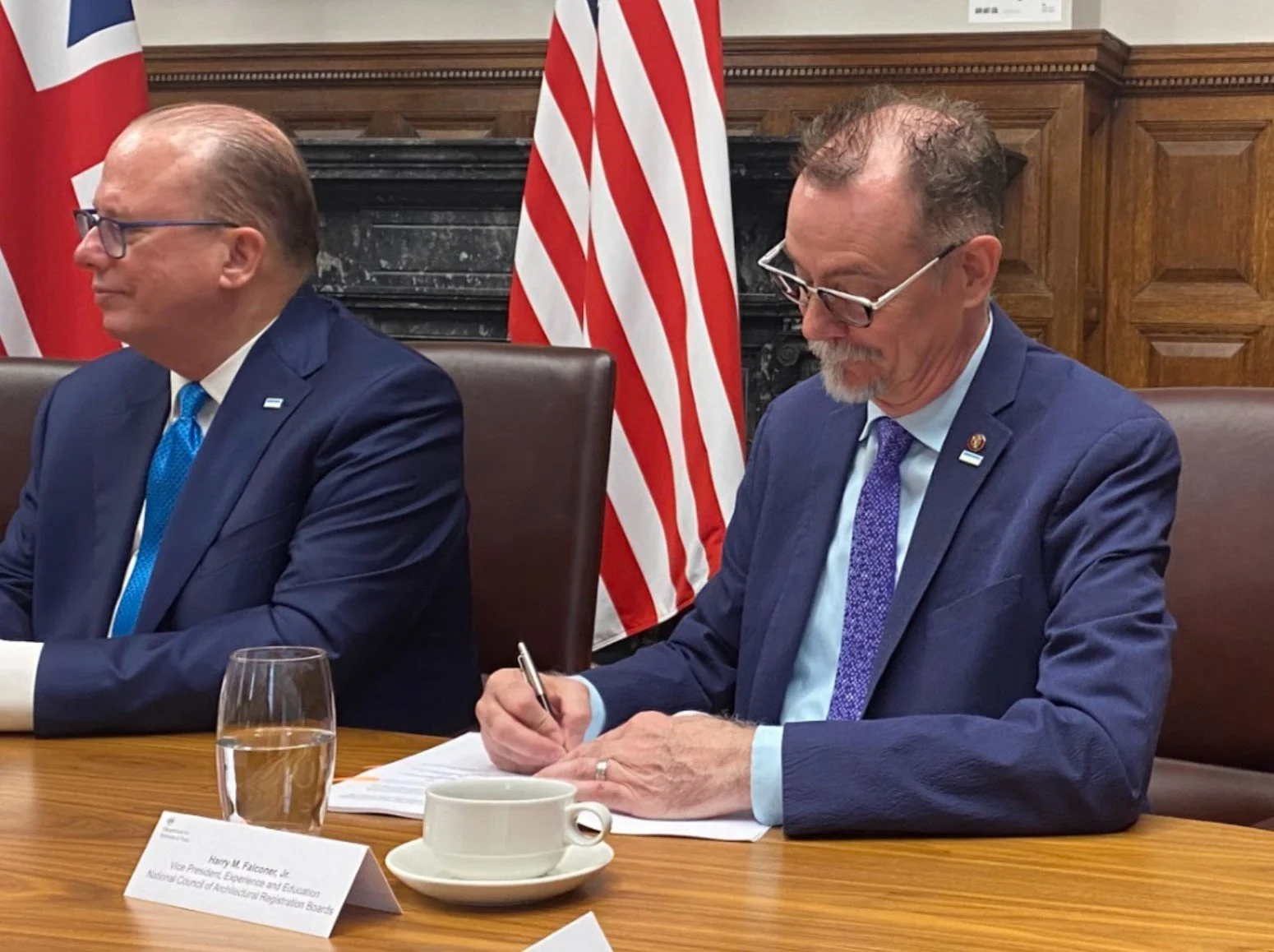
Harry Falconer, Jr. (NCARB) signs the MRA document. Seated next to him is Michael J. Armstrong (CEO NCARB). Photo by Adelina Koleva, AIA.
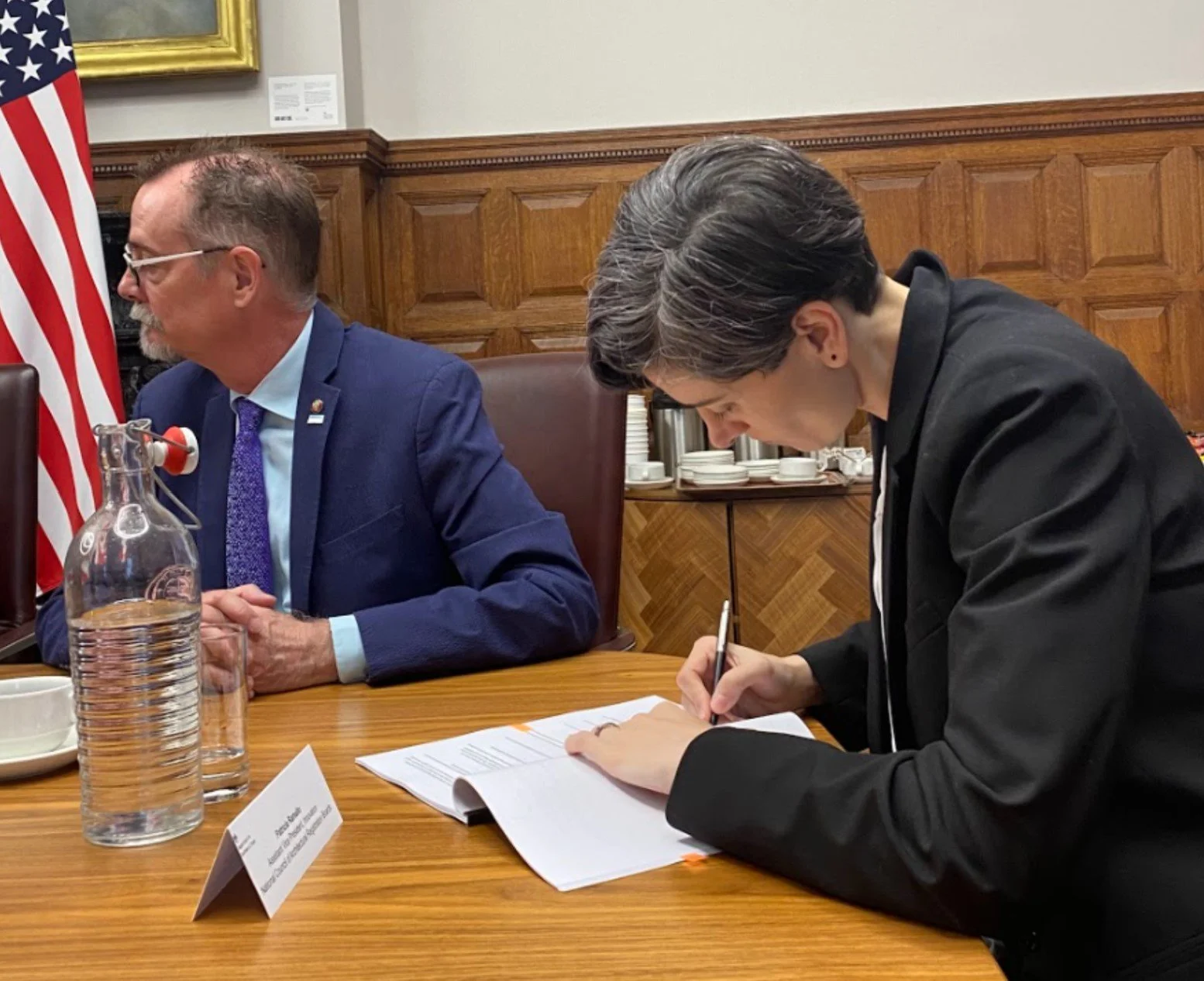
Patricia Ramallo (NCARB) signs the MRA document. Seated next to her is Harry Falconer, Jr. (NCARB). Photo by Adelina Koleva, AIA.
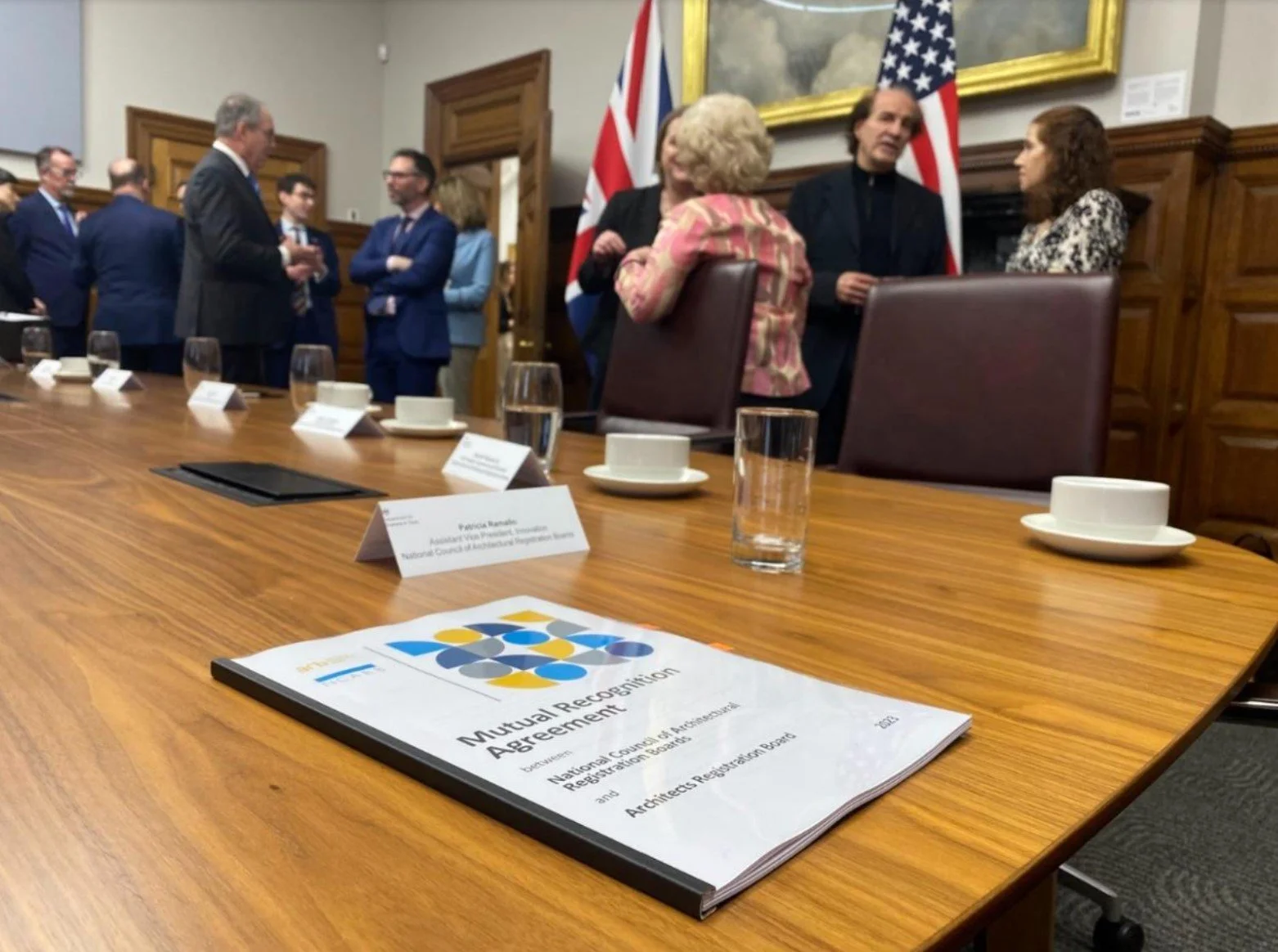
The final signed US copy of the MRA document rests on the table at the Churchill Room of the Old Admiralty Building in London. The agreement represents an international collaborative effort by ARB and NCARB to determine the rules and requirements necessary for architects to demonstrate professional competency. Photo by Adelina Koleva, AIA.

AIA UK President Gregory Fonseca (pictured, centre-left) was invited along with AIA National President Emily Grandstaff-Rice (pictured, left) by ARB CEO Hugh Simpson to represent the US architecture profession at the signing event. Photo by Adelina Koleva, AIA.
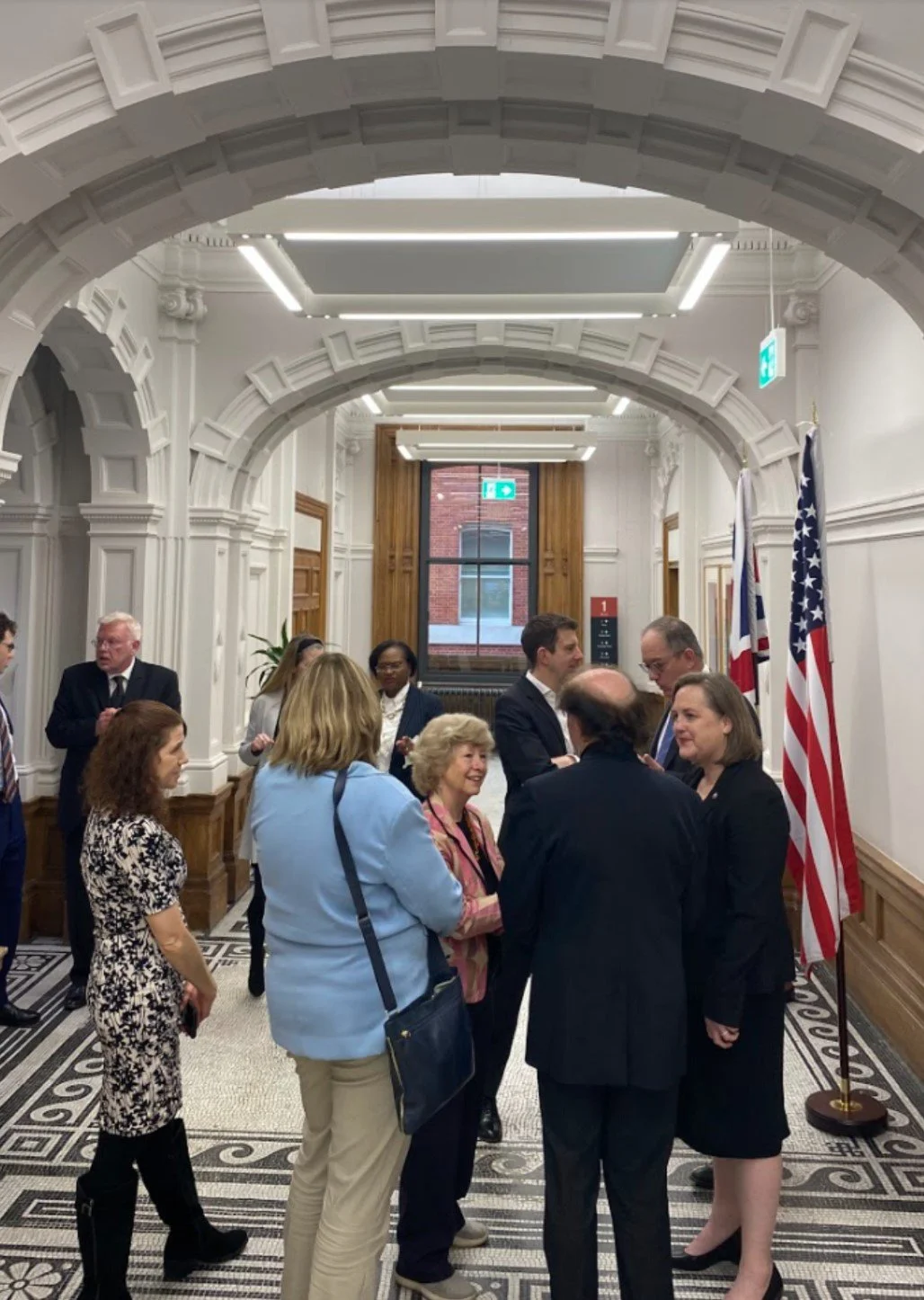
Attendees gather outside the Churchill Room in the Old Admiralty Building at the UK Department for Business & Trade. Standing in the centre of the photo wearing a pink jacket is Rosemary Gallant, the Minister Counsellor for Commercial Affairs at the US Embassy. Photo by Adelina Koleva, AIA.
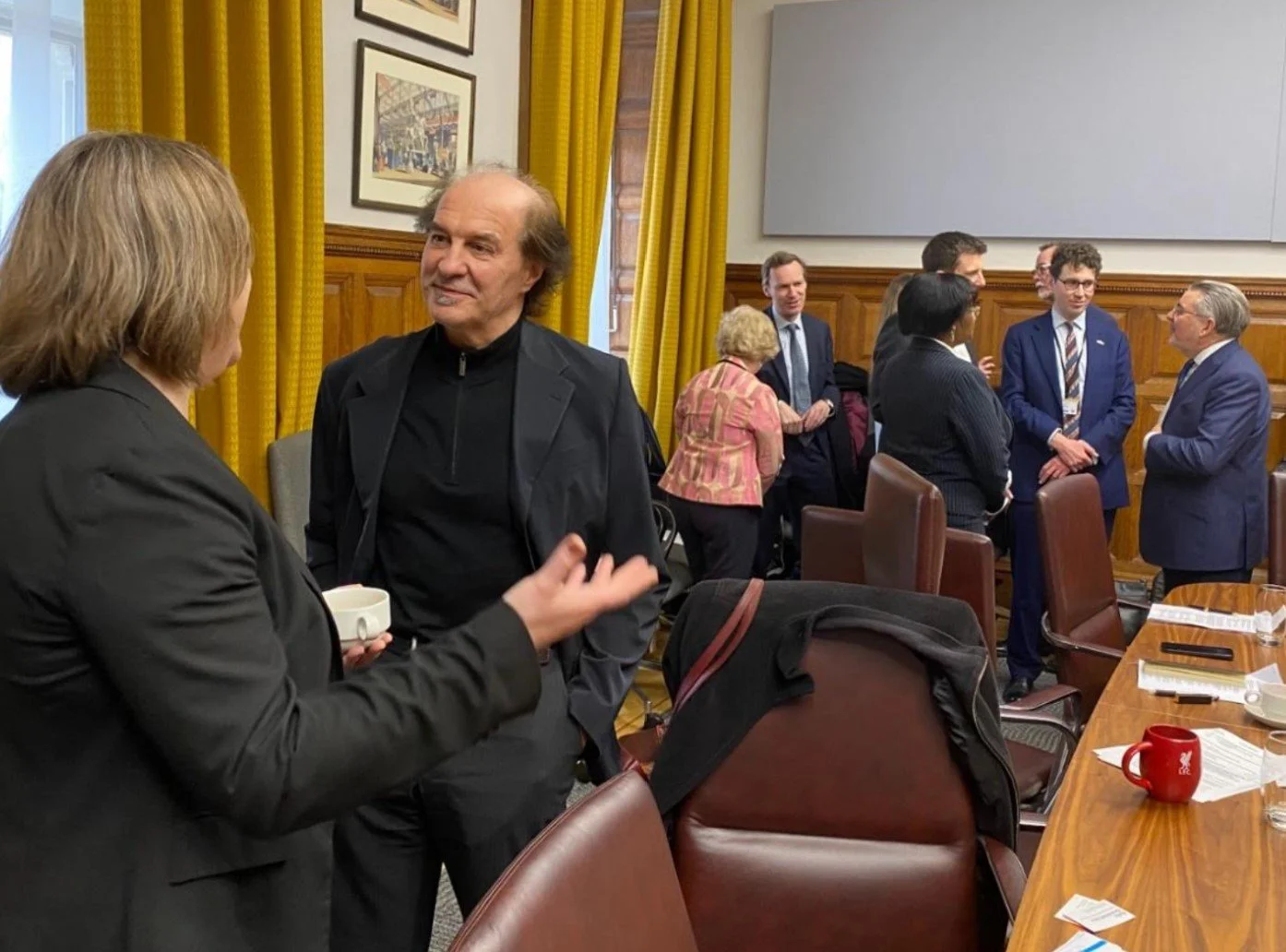
2023 AIA UK President Gregory Fonseca in conversation with AIA National President Emily Grandstaff-Rice ahead of the signing. Photo by Adelina Koleva, AIA.
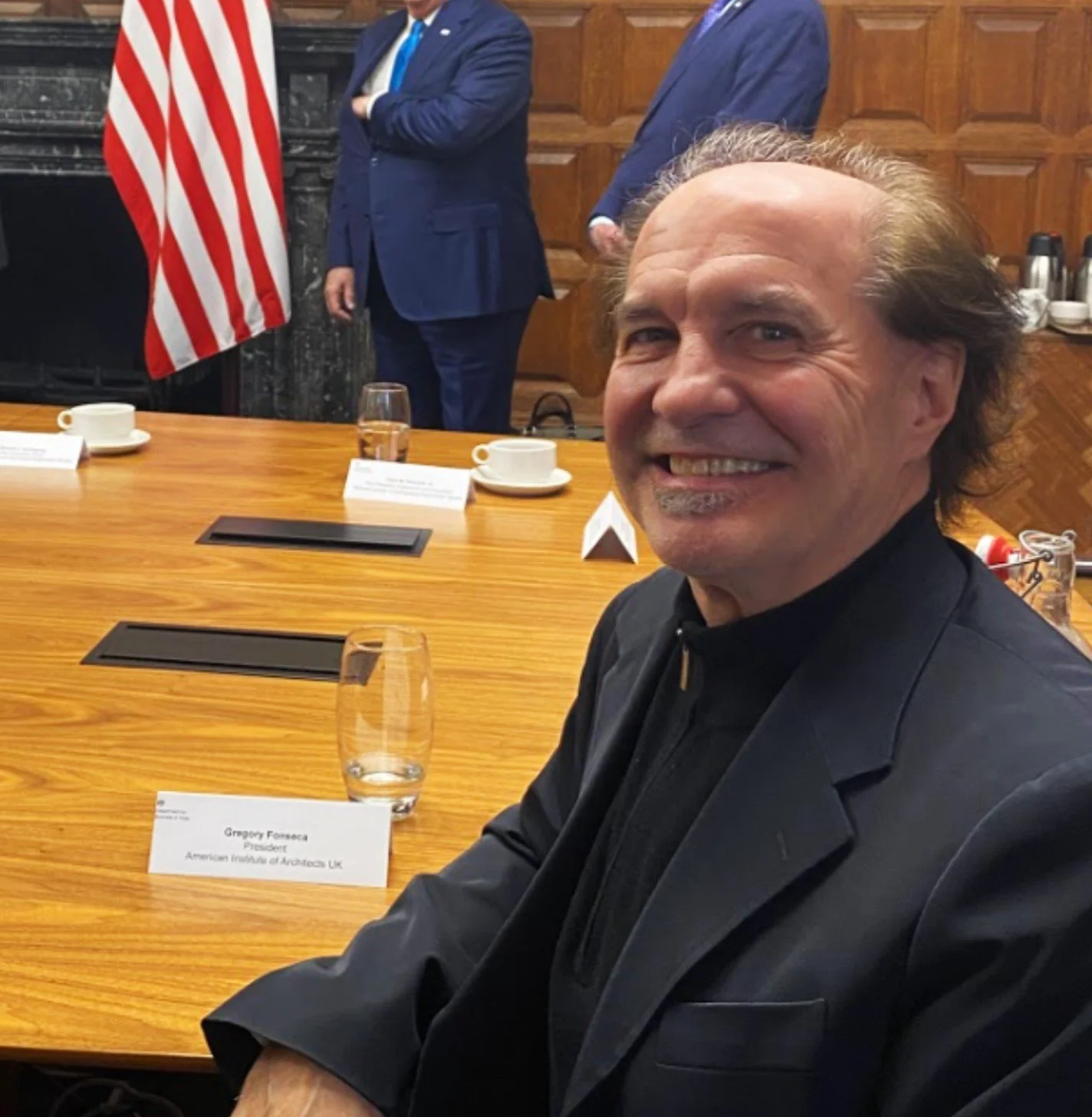
2023 AIA UK President Gregory Fonseca pauses for a celebratory photo at the MRA signing event in Whitehall. Photo by Adelina Koleva, AIA.

Following the signing, NCARB and AIA executives shared a celebratory dinner with the AIA UK board at Roast in Borough Market. Pictured from left to right: Genie Khmelnitski (AIA UK), Gregory Fonseca (AIA UK), private guest/spouse, Bayliss Ward (NCARB), Paolo Mendoza (AIA UK), Katharine Storr (AIA UK), Adelina Koleva (AIA UK), Patricia Ramallo (NCARB), Lester Korzilius (AIA UK), Emily Grandstaff-Rice (AIA National), Harry Falconer Jr. (NCARB), Etain Fitzpatrick (AIA UK), Michael J. Armstrong (NCARB), private guest/spouse, Christopher Musangi (AIA UK).
LICENSURE MATTERS 3 / Reflecting On The US-UK Mutual Recognition Agreement (MRA)
Ten years ago, a collaboration between NCARB and ARB on architectural reciprocity would not have seemed possible. Not only did the UK’s membership in the EU precluded any professional agreements with the US – qualifications, and in some cases education, were not directly recognized by either country. At the time, the UK was nowhere near Brexit, and many people had to go through a process of repeating courses, paying exuberant fees, and submitting loads of paperwork while navigating an obscure and complicated system. The barriers to enter the profession in the UK from the US, and vice versa, seemed insurmountable.
How times have changed since then: it only took a national referendum, several prime ministers, and a global pandemic to reach a moment of clarity. When news broke of the new Mutual Recognition Agreement (MRA) in June 2022, it felt like a moment of absolution to many US-UK architects – though bittersweet for those that had to go through the hurdles. The significance of this agreement to US architects based in the UK, and indeed, the AIA United Kingdom as a chapter, cannot be overstated. While Mutual Recognition may not be as meaningful to those already established in practice, the forecast is heightened activity for the AIA UK Emerging Professionals committee and – we hope – a renewed appreciation for the AIA UK chapter from both the AIA and RIBA motherships.
A Comparison of US & UK Paths to Qualification
Licensure in the US is administered by NCARB (National Council of Registration Boards) and its national counterpart in the UK is the ARB (Architects Registration Board). Unlike the ARB, NCARB does not award licenses or keep a register of qualified architects; this is in fact handled by individual states or territories. Instead, NCARB handles the certification process which allows candidates to submit applications for license within individual jurisdiction. The NCARB Certificate can therefore be considered as a “passport” to practice in individual states. Some states only require the NCARB Certificate to register; others have additional requirements, which can be thought of as a “visa.” The California Supplemental Examination (CSE) is one such example.
To achieve an NCARB Certificate, candidates on the standard path must first complete an NAAB-accredited B.Arch. or M.Arch. degree program. The B.Arch. program lasts 5 years; M.Arch. programs can vary in length depending on previous education but can be up to 3 years and require an undergraduate degree. In addition to education, candidates are required to complete examination and experience criteria. These are the six Divisions of the Architect Registration Examination (ARE) (a standardized test) and 3,740 hours of practice hours across six experience areas under the supervision of a professional mentor. This practice component is known as the Architect Experience Program (AXP).
In the UK, the ARB takes on the same role as NCARB and additionally functions as a state or territory. Unlike NCARB, the ARB does award licenses and keeps a register of qualified architects. It also handles the education and experience components through the Criteria for the Prescription of Qualifications Parts I, II, & III. Part I relates to the first three years of university education, followed by two years of education for Part II (a diploma or a Master’s degree). Parts I and II are often bundled into the same degree program. In the UK, there is a practice of assigning individuals who have not completed Part III the title of a “Part I -” or “Part II Architectural Assistant,” regardless of educational background or professional credentials.
Once the Part I/II educational criteria are complete, the final Part III fulfils the examination and experience requirement. The experience component consists of 24 months in architecture practice while completing a Part III accredited course. Unlike the ARE sit-down test, the ARB Part III examination component is an assessment process involving a professional review, preparation of case studies, a written examination, and an interview. The Part III examination is perhaps more comparable to NCARB’s AXP program than the ARE, whereby the qualified architect supervisor fills a similar role to the Part III examiner. At present, there is no standardized test requirement for architects to enter the ARB register.
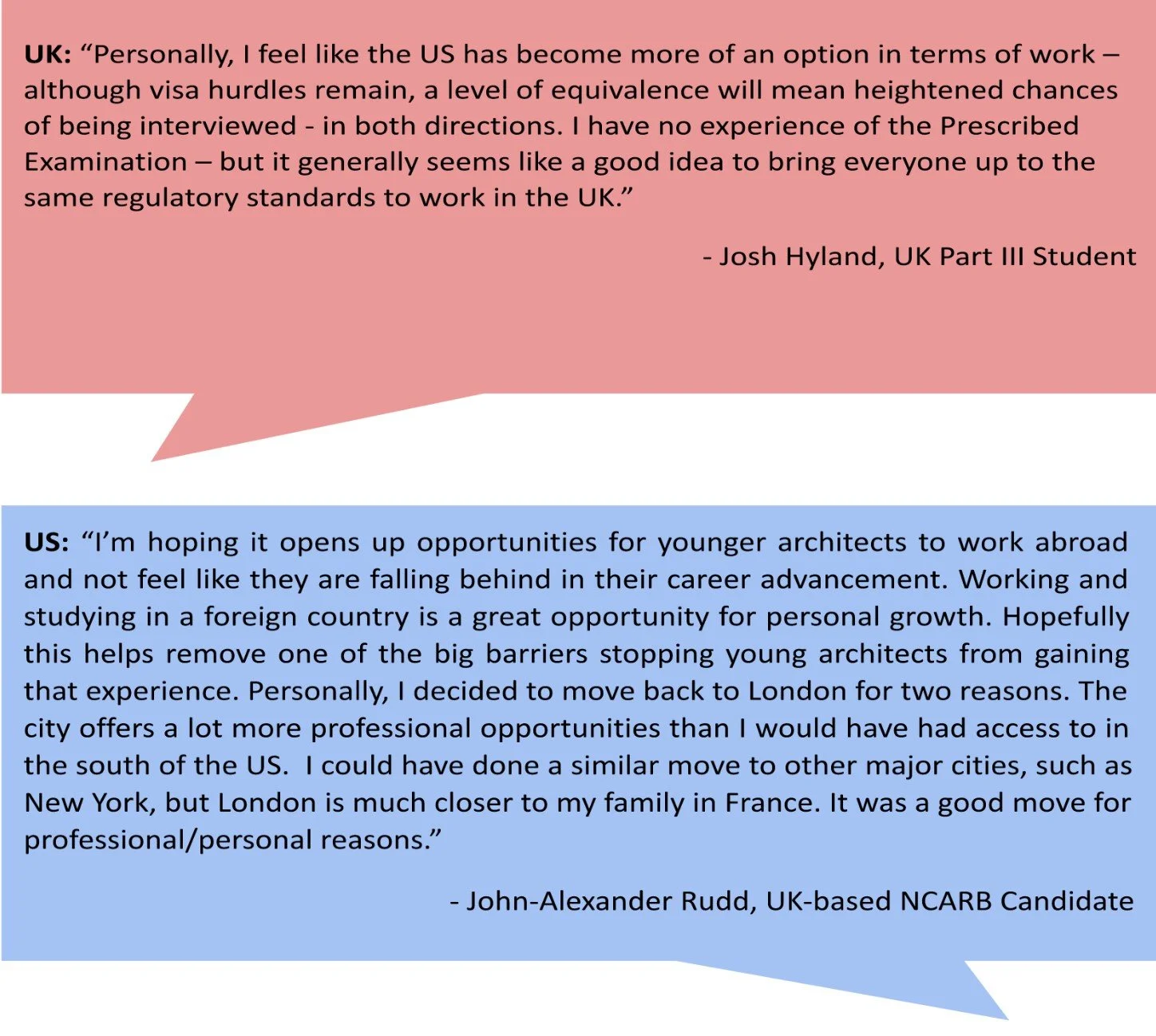
How would you describe the process of qualification in the UK / US?
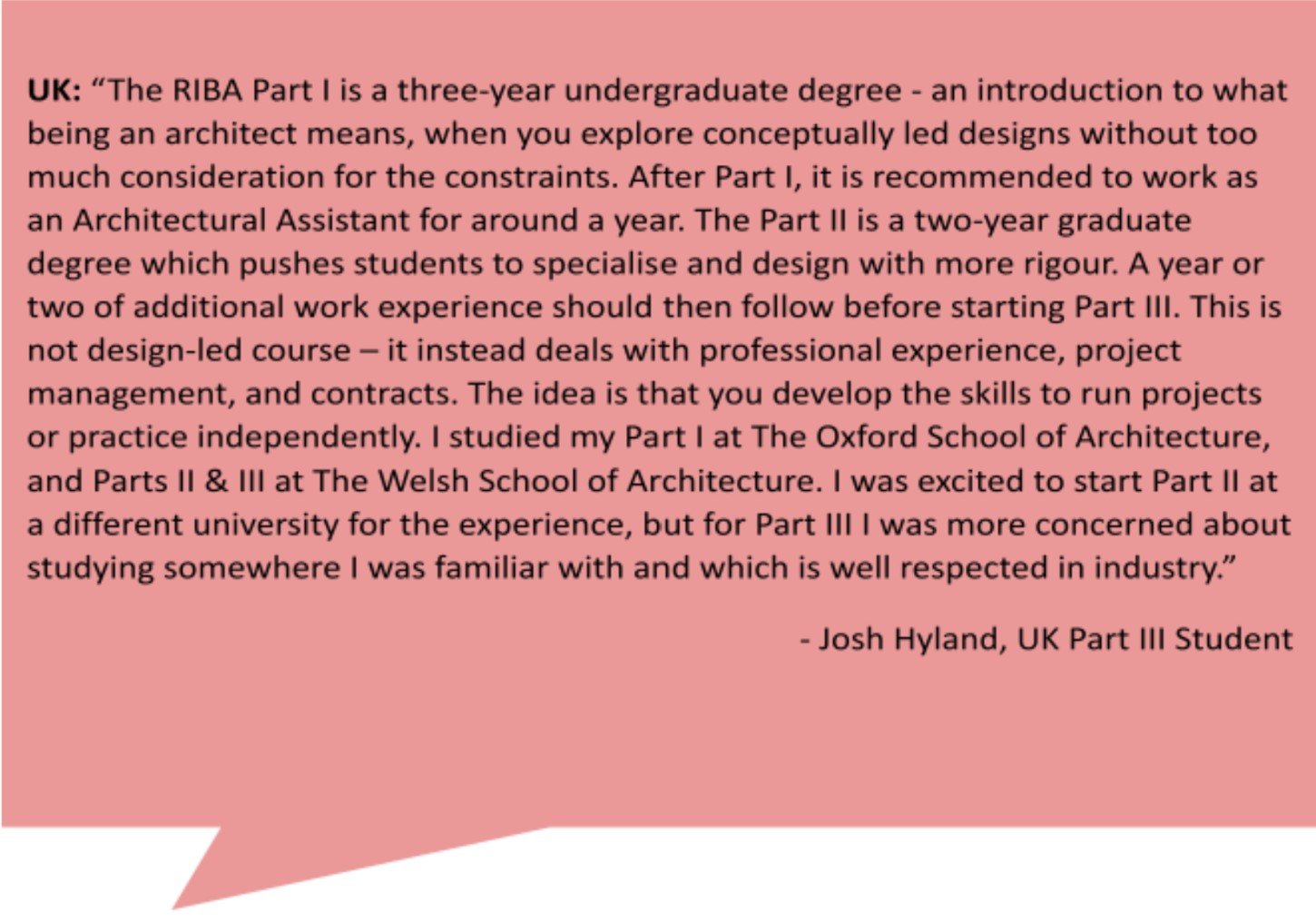
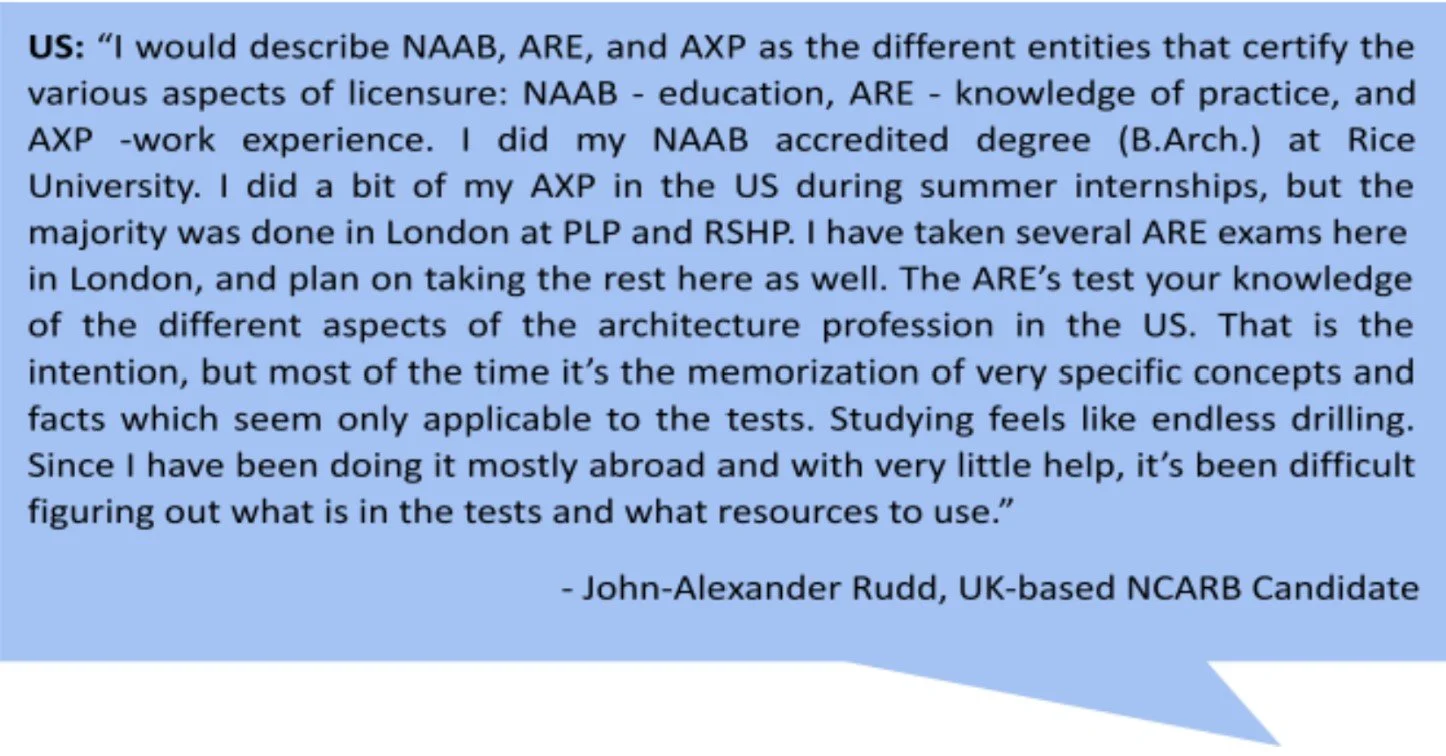
How do you think the MRA will be useful for UK / US students and architects?
UK Registration as a non-UK Architect
The current method for registering as a UK architect without the ARB-accredited Parts I/II is through an “Alternative Route to Registration,” specifically the ARB Prescribed Examination. This is the process AIA members have used in the past to qualify in the UK in absence of an MRA agreement, but it can be quite demanding. Like the standard Part III examination, it requires interviews and portfolio work to demonstrate equivalency. The problem is that these applications are expensive and can be rejected. It is therefore vital that candidates take extra care and seek sound advice in preparation. Experience in the UK is likely advantageous in understanding how to demonstrate the necessary competency. If the Prescribed Examination is successful, the candidate would then be required to complete the Part III to join the UK register.
UK Registration as a US Architect (MRA)
If the ARB accepts the non-UK education or experience – waiving any one of the Parts I or II requirements – this likely will not allow the individual to take advantage of MRA agreements. This would be because the candidate obtained a UK license via an "alternative route" (non-UK education); subsequently, if that same candidate wished to register in the US, likely they cannot use the UK qualification to obtain an NCARB Certificate.
Currently, only the “standard route” is allowed on either side of the US/UK MRA. This measure excludes non-UK and non-US architects from taking advantage of reciprocity via a US or UK license. For this reason, it is also not permitted to qualify in the UK via another MRA; for example, a Mexican architect qualified in the US via the US/Mexico MRA cannot use the US certification to qualify in the UK through the US/UK MRA. Such arrangements are not possible at this time. Nonetheless, the ARB has expressed a wish to investigate such options in the future.
The implementation of the new US-UK MRA will transform the process for US architects to register in the UK, and vice versa. For US architects, the NCARB Certificate – and a supplementary test – would be the only requirement. (This measure is intended to entirely replace the prior Prescribed Examination requirement for NCARB Certificate holders.) This remains to be confirmed as more information becomes available. At the time of writing, the ARB is still waiting on the UK Parliament to complete its legislative process to complete the Agreement. The estimated date is early 2023.
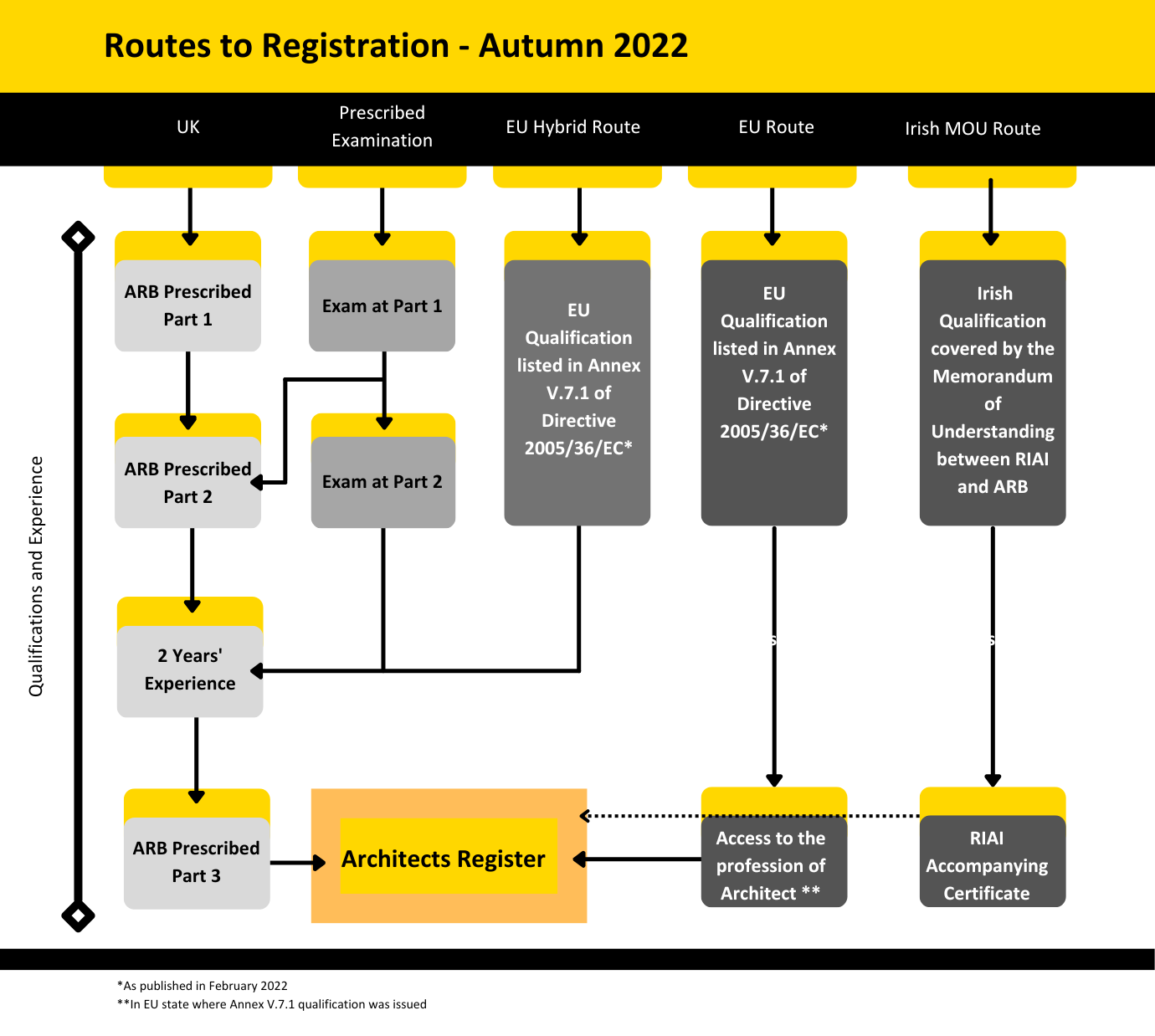
A diagram of the Alternative Routes to Registration in the UK with architectural education that is not recognised. Foreign architectural qualifications, other than Irish, are not currently recognised. However the ARB is currently working on MRA agreements with other countries that will circumvent this restriction, so opportunities will likely improve in the future following Brexit. For more information, please consult the ARB website. Image source: ARB Website, click HERE to view
US Registration as a non-US Architect
Unlike the UK, the US consists of multiple licensing boards that are managed by individual states. NCARB operates on a national level to standardise and manage most requirements set forth by the individual boards, but not all of them. Therefore, registering as an architect in any US jurisdiction will typically be facilitated by an NCARB Certificate obtained through the “Foreign Architect Path.”
Non-US qualified architects have the option to pursue an NCARB Certificate by verifying the qualification and completing the two education and experience components: the Architectural Experience Program (AXP) and the Architect Registration Examination (ARE). Alternatively, non-US candidates without a NAAB-accredited education have the option to request an educational assessment through a program called Education Evaluation Services for Architects (EESA). The EESA evaluation is administered by the NAAB organisation and compares academic transcript(s) to the NCARB Education Standard. The process will determine the education meets the standards for (a) initial licensure in a jurisdiction, (b) NCARB Certification, or (c) reciprocal licensure between jurisdictions. The evaluation will also identify whether any additional education is required.
Once the non-US candidate obtains an NCARB Certificate, this may only be used to apply for an initial license in a U.S. jurisdiction that accepts an NCARB Certificate issued through the Foreign Architect Path. The NCARB Certificate may allow additional registrations in US jurisdictions more easily; however, it is necessary to check the requirements of the individual jurisdictions to ascertain whether the specific case allows for this.
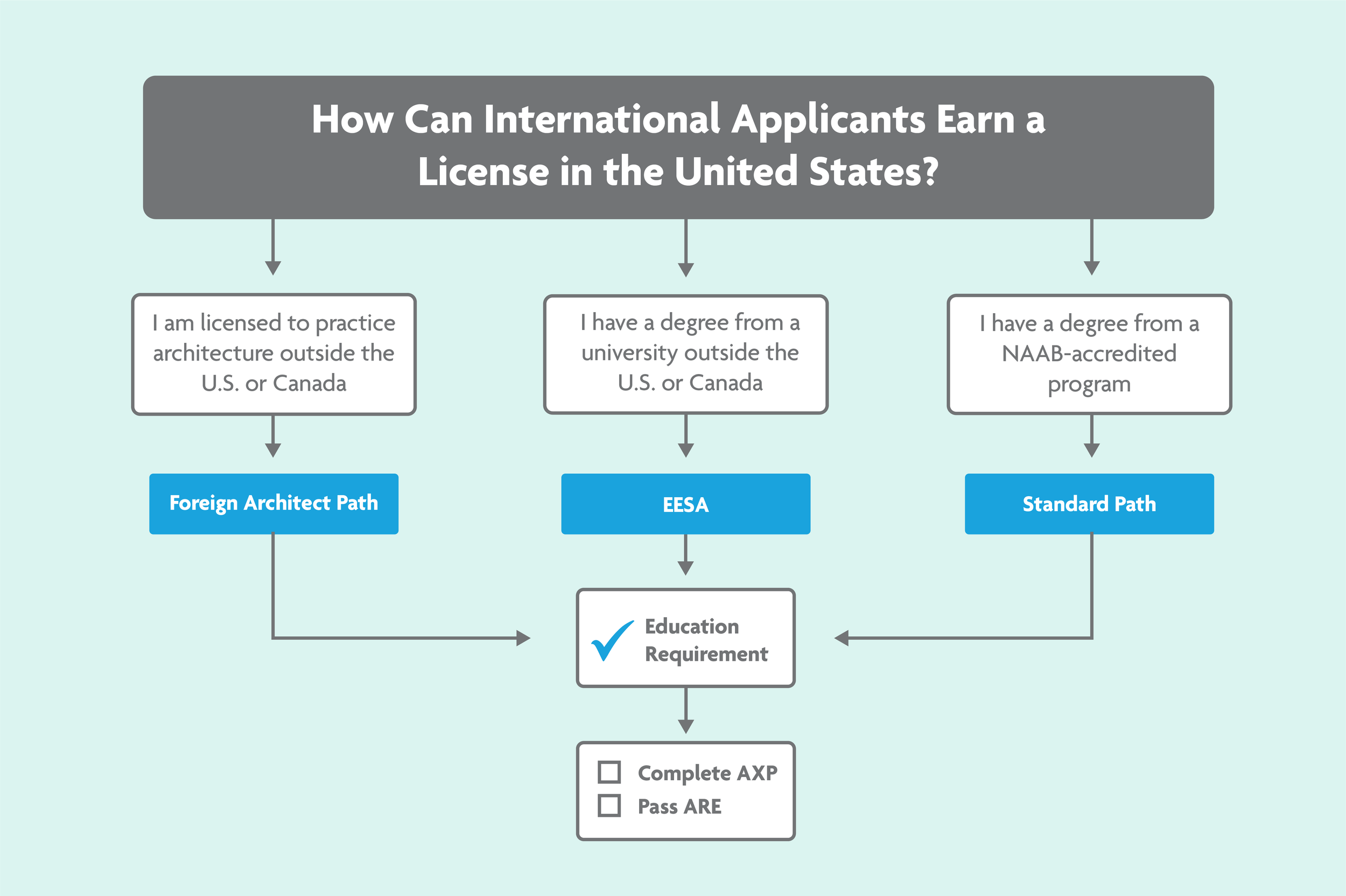
A diagram of the Foreign Architect Path to licensure in the US with either an architectural license or architectural education that is not recognised by the respective US organisations responsible for certifying. Though full of hurdles, the Foreign Architect Path is not impossible and will likely improve in the future. For more information, please consult the NCARB website. Source: NCARB Website, click HERE to view
US Registration as a UK Architect (MRA)
The implementation of the new US-UK MRA will transform the process for US architects to register in the UK, and vice versa. For UK architects, it is likely that the ARB qualification will earn an NCARB Certificate directly with no other requirements; however, this remains to be confirmed as more information becomes available. It is important to note that like the “Foreign Architect Path”, an NCARB Certificate obtained through the US-UK MRA may not be accepted in all US jurisdictions. It will therefore again be necessary to check the specific requirements of each jurisdiction before deciding where to apply for an initial US license.
This article is a continuation of the 2022 LICENSURE MATTERS series. This is an ongoing story; please refer to NCARB and ARB for the latest information.
Written by Adelina Koleva, AIA